Showing posts with label Scranton. Show all posts

Saturday, January 15, 2022

Four Leadership Lessons Learned from St. Paul's Crusaders

Leadership is taking limited information and striking down a path with the commitment needed to succeed in the endeavor. It is motivating others to follow you into uncertainty, while maximizing their ability to contribute to success. It is filling each teammates emotional tank so they self-motivate to maximize their strengths and contribute to the team. 

I moderated a strategic planning retreat where bankers were debating employee development. A senior manager quipped about "coaching." The CEO asked, "do we really coach?" "I'm reading a book by Bill Cowher (former Pittsburgh Steelers head coach), and we don't do what Cowher has done."

Coaching sports is a highly accountable form of leadership. Are you maximizing the talents of individual team members? Are you improving how they work together to create a high functioning team? In sports, the results are on the board. Wins and losses. Statistics for nearly every function. In my book, Squared Away: How Can Bankers Succeed as Economic First Responders, I told how the Positive Coaching Alliance helped me become a better girls lacrosse coach, and as a result, a better leader.

The banker's comments on Coach Cowher got me thinking about coaches in my life and what they taught me about leadership. Two such underappreciated coaches were Coach McLaughlin and Coach Hewitt from my middle school basketball team: St. Paul's Crusaders in Scranton, Pennsylvania.


St. Paul's

First, a little background. Most people that grew up in Scranton when I did were Catholic. And the middle school Catholic basketball league was highly competitive. St. Paul's usually fielded an excellent team, as was the case in 1979-80. 
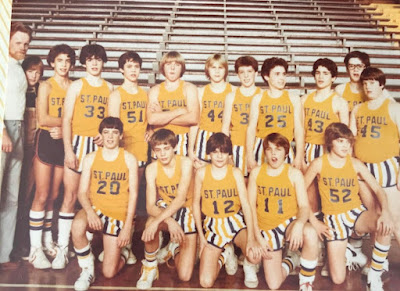


I was an average player at best. A couple notches down the bench from our best. But I had some skill and probably more potential. But my attitude got in the way. I could have been a better player. But I thought the effort wasn't worth it because I was, shall I say, in a different economic situation than most of my teammates. My father passed away when I was young. Most of my teammates had both parents, and were more affluent than me and my family. I was fortunate to receive discounted tuition so I could attend the school. My mother told me that my father, prior to his death, asked her to keep us in Catholic school as long as she was able. 

This situation resulted in a chip on my shoulder that impacted my attitude, and therefore my effort. Why put forth what it will take to hone my skills only to see the privileged kids get the playing time anyway? This attitude manifested itself when a player brought up from the 7th grade team started getting more playing time than me. I promptly quit.

I was deep in the victim rabbit hole.

But my coaches wouldn't let me go. Although, looking back at it with open eyes, they should have. My bad attitude was impacting other players. My biggest regret from 8th grade basketball was not my attitude and effort, and the ease that I painted myself a victim (although both were lamentable); it was that I influenced others to share my victimhood. 


Lessons Learned

What did I learn from Coaches McLaughlin and Hewitt that are instructive for us as leaders?


1.  Think Big Picture. I was what is currently termed an "at-risk" kid. I was in a single parent household where the parent worked and my choices would have a big impact on the direction of my life. I didn't know this. I was 14! But my coaches did. If they allowed me to quit, how would I spend that newfound time? And how could they influence the direction I took? In other words, how could they coach me? If you are challenged by team members with a bad attitude that impacts their effort and performance, think about how you can positively impact that person's trajectory and be a transformational person in their lives. I'm not suggesting tolerating or ignoring the attitude issue, but tackle it in such a manner that makes them better and a team contributor. 


2.  Reward great attitude and effort consistently. As my attitude worsened, and my effort slipped, it opened the door for another player, likely without as much talent and potential as me (although it is difficult to self-evaluate), to get more playing time. This is exactly what happened at St. Paul's. My sulking on the bench led to another player's opportunity. He had a great attitude and worked really hard in practice. In fact, his hard work actually served as part of my rehabilitation. How can I slack while this kid is working it? The coaches rewarded him with more playing time for his attitude and effort. Even at 14, I realized it. And he deserved it. That kid went on to be a positive contributor to his high school basketball team.


3.  Learn the "Why". What if my coaches viewed me without context? Me quitting should have been accompanied by them muttering "good riddance." In my dark days of victimhood I was a detriment to the team. I was negatively impacting other players, my teammates, my friends! It would have been a very bad day for the direction of my life if my coaches had no context to my situation and what was driving my attitude. They took some lumps from me. They were stern when they needed to be. More so with me because of where I was, my behavior, and my situation. Short term I might have thought their treatment of me was relating to my economic and family situation. In retrospect, they understood my situation and tried to be the coach that I needed at that time. Each person needs something different from their leaders. It is the leaders' job to find out the "why" and approach the relationship from that context.


4.  Communicate! In a 2013 article, Lead Like Lincoln, I highlighted communication as one of our former president's greatest leadership traits. During the Civil War, I doubt any of the top generals asked themselves "I wonder where Lincoln would stand on this?" He used to communicate directly with his generals so there was no doubt where he stood on the big issues. Communication is a two way street. As the saying goes, you have one mouth, two ears. Active listening is important. When communicating with a 14 year old, my coaches not only had to listen to what I was saying, but the nuances as to what I was meaning. I certainly wouldn't come straight out and say "Why bother trying? The privileged kid has my position locked down." Classic don't try-can't fail. Even to someone my age, that would sound petty. So my coaches communicated what they were doing, and my role in it. This probably brought me back from the brink on that day that I handed in my uniform. I realized what they wanted and my role in it. They understood my attitude, and eventually I learned the basis for my attitude was wrong.


I got over it. Although it took time, and was a process not an event. By the time I crawled out of the victim rabbit hole I was no longer in middle school. So perhaps my coaches never knew the impact they had on me. But it was profound. And I have been a crusader against painting myself a victim ever since. And I credit the transformational leaders that helped me on the journey.


Thank you Coach McLaughlin and Coach Hewitt!


~ Jeff


Monday, January 05, 2015

Leadership: In My Own Words

With all of the scholarship on leadership, what could I add to the conversation? I have my ideas. And if we reflect on the decline of our industry, an honest in-the-mirror assessment of bank leadership merits discussion.

In 2004 I wrote an article for a banking industry association entitled Lead Like Lincoln. The article identified three traits that were critical to Lincoln's success: Vision, Communication, and Commitment. Ten years later, I stand by those traits.

At this stage of the post, I could cite studies, books, and management luminaries on what makes great leaders. Instead, I will give you my slightly varnished view, straight from the gut. Slightly varnished because I grew up in Scranton, where directness has greater value than tact. Not always an admirable trait for a consultant, or a leader.

A great leader has a vision for the future. This is particularly important and challenging in rapidly changing industries like technology and media. It was not particularly important in slow moving industries like banking. 

But that has changed. The greatest banking leaders can see their bank several years into the future, and organize resources around making that vision a reality.

A great leader is humble. As with any general statement on leadership traits, there are exceptions. Say what you will about Steve Jobs. Humble he was not. But hard charging, egotistical leaders can only move an organization so far, and to a certain size, before the ego starts to become a liability. Recall that Jobs got fired from the company he founded. Not an easy task to accomplish. 

The humble leader, on the other hand, takes counsel from his/her people and understands that no human being is all knowing, or even close to it. A great leader does not judge his/her importance by an org chart or the size of paycheck, but by the happiness of their people (sum total of all of their people, not just keeping an individual happy) and the purpose of their work

A great leader does not fear failure. Failure is the lesson plan for success. Avoid failure, and the leader understands that their company is destined for the ash heap of irrelevance. In banking, failure is clearly a dirty word when relating to the overall bank. But the most innovative and sustainable business models in our industry are moving farther away from business as usual into less tried and true paths. If there was ever a need for great leaders in banking, now is the time.

A great leader has great followers. When the Navy trained me on leadership, an early lesson was that before becoming a great leader, a sailor must be a great follower. So before assuming leadership, a future leader supports their current leader, working with purpose for the betterment of the company, with no interest in highlighting shortcomings of their leader or those around them in order to move them up the organizational ladder.

Surrounding yourself with great followers implies hiring those that can step into your shoes, or that have such potential and you are dedicated to ensuring their development. Great followers are smart, motivated, humble, forward looking, and care about their colleagues and the company. 

Great followers give the leader informed information and opinions, and if the leader, after careful reflection, decides to go against the follower's recommendation, the great follower charges forward lock-step with the leader.

Poor leaders don't want great followers for fear that they can easily slip into the leader's shoes. Great leaders cheer their followers and prepare them to slip into the leader's shoes.

Great leaders are committed. If a vision is worth pursuing, should it be abandoned when obstacles rear their inevitable head? Weak leaders cut their losses. Great leaders forge forward.

Great leaders are likable. By this I don't mean liked by everyone at all times. They can make the difficult decisions, counsel employees, and be firm when necessary. But if a leader must motivate employees to challenge their boundaries and create great companies, employees must believe in the man or woman. 

Can a person with wavering honor or integrity, or is generally a jerk get the entire company to move as one in a direction that has great risk yet may lead to great reward for a sustainable period of time? 

I think not. 

What are your thoughts on leadership in financial services?


~ Jeff


Tuesday, July 03, 2012

Random Stuff About Me

A tweep of mine, Ken Mueller (@kmueller62), posted an interesting bio-post titled "Random Stuff You Should Know About Me" on his Inkling Media blog. I saw his reference to it on Twitter, I read it, I enjoyed it, so I decided to copy it... with Ken's blessing of course.

A key benefit of blog writing versus newspaper journalism is the ability to let readers know more about you than is reflected in a typical journalist's bio page. Actually, journalists like to hide many things about themselves for fear of exposing their bias, as if we can't discern their bias by reading their articles. In blogging, we have no need for the facade.

So here are some random things about me you might (or might not) find interesting and give you some greater insights into the person behind the words.

I grew up in Scranton, Pennsylvania. Veep Joe Biden once quipped that it was a "hard scrabble life" growing up in Scranton. It must have been hard for him since he moved out when he was a child. I went the distance. Scranton is lampooned in the popular sitcom The Office. Although I would characterize Scrantonians as quirky, we are not quirky like those in the series. I think we would be funnier. Scranton is an amalgamation of European immigrants that came over the pond between the Irish potato famine and the southern European immigration wave that ended in the 1920's. We are Irish, German, Polish, Italian, Czech, and various other nationalities that came through Ellis Island to the land of plenty to mine coal. I am of Italian and Irish descent. I have a lot of internal conflict. My wife is Sicilian. I sleep with one eye open.

I am wired to engage my tongue before my brain. This is an offshoot to being a Scrantonian, as many of us suffer from the same affliction. It is not an endearing quality for a consultant. I have made considerable progress with this shortcoming. But be careful asking for my opinion. Because you may very well get it without the benefit of a filter.

My sports allegiances are... You can read these on my Twitter bio (@JeffMarsico). But you may be curious as to the why. Here goes. Yankees: When you grow up in Scranton, you like the Phillies or Yankees, although there were smatterings of Mets and Pirates fans, but why torture yourself? My older brother liked the Phillies. Ipso facto, I'm a Yankees fan. This logic did not apply to me liking the Sixers, as all of my brothers do. Dr. J, Moses Malone, Mo Cheeks, Bobby Jones, Chocolate Thunder! C'mon, like anybody else and I'm not sure you followed basketball back then. St. Louis Rams: This one is out in left field, I will admit. But in 1974 the Rams drafted the only Heisman Trophy winner from Penn State, one John Cappelletti. Perhaps you saw the movie Something for Joey, where Cappy gave his Heisman to his little brother that was bravely suffering from Leukemia. I cried... and I never liked another professional football team. Notre Dame: You either liked Penn State or Notre Dame if you were from Scranton because 90% of us were Catholic and we had a fair amount of Irishmen. My older brother liked Penn State. Enough said. Washington Capitals: I never watched hockey growing up, so this is a later in life decision. The Caps farm team is the Hershey Bears, eight miles from my house. I saw many Caps play when they were young'uns. Philadelphia Union: I never saw a game of soccer until I was an adult. I had the same attitude as baseball and football fans. But my 13yo is pretty good at the sport, and I must admit it has grown on me. Soccer fans, by the way, are awesome. And check out the pic of PPL Park. What a great place to watch a soccer match.

I coach youth girls lacrosse. Note above that there are no favorite lacrosse teams. Because, like soccer, I never saw a game or even knew the sport existed. Even if I did, I would not have played girls lacrosse, which is a different sport than the boys variety. But I have noticed mixed results when parents coach (disclaimer: my 13yo also plays lacrosse and on my team). And when they asked for volunteers, I begrudgingly raised my hand, knowing I would work my tail off to learn the sport, how to coach, and how to develop young ladies into productive players and members of society. Lofty goals. It's still a work in progress. But coaching middle school girls nets a treasure trove of quotes, such as: "Coach, I'm on my period and will probably be a b**** tonight." Or, "Coach if you send me out there I'll probably pee on the field." It also helps with my personal goal of developing more patience.

I am uncomfortable with opulence and putting on airs. I grew up on the lower rungs of the socio-economic ladder. The first family car I remember was the Dodge Dart Swinger. My dad passed away when I was six. I had the same glove, bat, and cleats all through high school and I rode the shared family bike to games when the local tuff kids didn't steal it. So I am not used to a life of driving luxury vehicles, staying in swanky hotels, and sipping single malt scotch. Some of these things are the trappings of my profession, and I don't rebel by going to the local Econo Lodge when my colleagues stay at a top tier hotel. But I drink beer. I drive a Chevy. I'm sorry if that makes you think I am not successful.

There you have it. I could go on and on, but I get bored myself when blog posts get too long. However, if you have any questions, fire away. I would also like to know some factoid(s) about you, so feel free to share.

~ Jeff


Tuesday, September 14, 2010

Ficticious Interview: Senator Chis Dodd and Rep. Barney Frank

Senator Chris Dodd (D-CT) and Representative Barney Frank (D-MA) were primary sponsors for the Dodd-Frank Wall Street Reform and Consumer Protection Act which was signed by President Obama on July 21, 2010. Rather than arrange for an actual interview with the lawmakers so they can give me non-answer answers, I envisioned how an interview with the esteemed gentleman might transpire. Here is how it played in my head:

jeff-for-banks (jfb): What is your definition of a "financial crisis"?

Dodd: When Joe the Plumber can't get a loan to buy a multi-million dollar home on Florida's Gold Coast. That's not just a crisis, it's tragic.

Frank: When Fannie and Freddie stop contributing to my PAC.

jfb: How did the Government Sponsored Entities, such as Fannie Mae, contribute to the financial crisis?

Frank: I don't think Fannie and Freddie are financially insolvent. I don't believe they require large bailouts (Note: Actual July 2008 quote by the gentleman from Massachusetts. See video below).

Dodd: Barney just told you they stopped contributing.

jfb: Should individuals be accountable for taking loans they could not afford to repay?

Frank: The necessary evil of capitalism is that there are evil forces intent on perpetrating ill-will on the working class and it is the responsibility of everyone to enlist government officials to stand guard against bad players regardless of the cost and reliance on government because we are here for you, the working class, not the rich.

jfb: Huh??? Senator Dodd, same question.

Dodd: Personal responsibility is so 1950's. It took the 60's enlightenment to end such a fascist concept.

jfb: I read that the Bureau of Consumer Financial Protection will have a $500 million annual budget. Is this accurate?

Frank: I hope not. Creating this bureau was a key provision in Dodd-Frank and a budget that doesn't end in a "B", or better yet, a "T", doesn't demonstrate our commitment to creating a black-hole bureaucracy.

Dodd: No worries. We'll charge it!

jfb: The Durbin Amendment requires the Fed to determine the "reasonable and proportionate" interchange fee that can be charged on debit and credit card transactions. Historically, when has price fixing worked?

Dodd: Nixon did it in the 70's with gas prices.

Frank: (laughs) Son, I understand you're a coal cracker from Scranton, had a hard-scrabble life, and may not understand these things. The Durbin Amendment is not price fixing. The Fed is only going to set the reasonable fee that can be charged.

jfb: How do you envision the Fed determining which systemically risky firms to unwind during a future financial crisis?

Dodd: Although the law is 5,000 pages, we left it up to the Fed to determine how to do that. I'm sure they'll do a good job.

Frank: I envision a panel like on the reality TV show America's Got Talent. Bankers like Jamie Dimon can make their case to Piers, Sharon, and Howie who can buzz him if they don't like his shtick.

Dodd: (laughing) Barney's kidding.

Frank: No I'm not. I love that show. Great concept.

jfb: Will Dodd-Frank solve the problems that created the financial crisis?

Frank: We are creating a financial system with greater government control and a new bureaucracy with a $500MM plus budget with significant powers. What could go wrong?

Dodd: What do I care? I'm outta here!

jfb: Thank you for your time gentleman.

Reminder in case you are an angry politico... the above was a figment of my imagination. Any complaints can be lodged to some government agency with a big budget that was designed so you can cry on their shoulder.

- Jeff