Wednesday, December 15, 2021

Row in the Same Direction: Branch Profitability in Practice

Chris Nichols from Southstate Bank Correspondent Bank Division recently wrote an excellent piece about branch profitability, a subject near and dear to my heart because it is one of our core competencies at my firm, The Kafafian Group, Inc.

In that piece, titled Branch Profitability in 7 Steps Using Data, Step 1 was start with Potential Branch Profitability. In that step, Chris made the case for calculating relative profitability to the competition using hypotheticals. And I thought, what if we didn't use hypotheticals? We used our actual profitability metrics, synced them up with our strategic plan, and calculated our journey from current profitability to desired profitability?

This is a tall order because in my experience, branch profitability is not widely calculated, and certainly not widely used in creating the operating discipline needed to deliver to the bank's stakeholders. Instead, it is more common to use easily available metrics that we can draw from our general ledger, core processor, or other systems. We measure aggregate deposit growth, period over period expenses, and number of accounts opened.

But what if this motivates behavior that is not consistent with strategy? For example, growing aggregate deposits might be aligned with overall asset growth objectives, but at what cost? It's a sure way to have the un-empowered branch manager calling the regional manager for rate exceptions to win new money or keep money at the bank. 

I rarely hear bankers state as a strategic objective to grow assets, loans, or deposits at any cost. But that is certainly what you are motivating branch managers to do if you use deposit growth as one of their strategic goals.

Instead, what if the bank aspires to be the number one business bank in their markets? And a strategic objective is to achieve top quartile cost of funds with an emphasis on growing business deposits?

How does that translate to the branch manager? What's their plan? 
I'm currently reading Extreme Ownership, How U.S. Navy SEALS Lead and Win, by Jocko Willink and Lief Babin. This book was given to me by a banker, by the way. In the book, the authors say this about empowering junior leaders, like branch managers (parentheticals are mine):


"Teams must be broken down into manageable elements of four to five operators (i.e. a branch), with a clearly designated leader (i.e. a branch manager). Those leaders must understand the overall mission, and the ultimate goal of that mission. Junior leaders must be empowered to make decisions on key tasks necessary to accomplish that mission in the most effective and efficient manner possible. Teams within teams (i.e. retail/small business banking-regionals-branches) are organized for maximum effectiveness, with leaders who have clearly delineated responsibilities. Every tactical-level team leader must understand not just what to do but why they are doing it."


So what of that Schmidlap National Bank plan: Vision-Be the number one business bank in our markets. Strategic Objective-Achieve top quartile cost of funds with an emphasis on growing business deposits.

The head of retail, or the regional manager if a larger bank, can set the strategic goal for the Elm Street Branch (My Branch in the below chart) to achieve top quartile deposit spread in the branch network. 
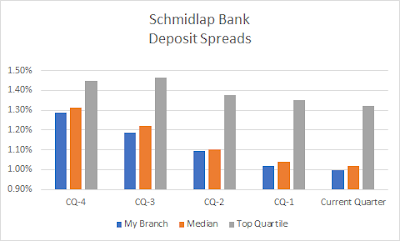


Deposit spread is a key metric in any worthwhile branch profitability system. Understanding how deposit spread is calculated and how to impact it is easily taught and understood. I wasn't from the Finance function, and I once was a branch manager, and I understand it. In fact, I believe not using branch profitability because we don't think branch managers, regional managers, or even the head of retail/ small business banking will understand it is patronizing. Or quite possibly you've made these reports overly complex. Which is the enemy of effectiveness.

No, I think My Branch's goal of achieving top quartile deposit spread by some future period is specific, measurable, aggressive yet achievable (a quarter of your own branches achieve it), relevant (to the strategic objective), and time based (i.e. a SMART goal). 

After setting the strategic goal, and ensuring the branch manager understands how it is calculated and how to impact it, the regional manager can then empower the branch manager to develop a tactical plan to achieve it. Some may include dependencies, as many of the Chris Nichols' "7 Steps" require Marketing support. This support can be coordinated over the franchise, as in "how will Marketing help our branches achieve their goals?"

But this doesn't mean the branch manager can't highlight tactics to help the branch succeed, such as: 


1. Develop list of businesses within five miles of branch by NAICS code, cross reference with existing branch customers.

2. Focus on the most promising businesses' in industries where our bank can be successful competitively.

3. Perform competitor analysis using Amberoon tool (Step 3 in Chris Nichols article)

4. Leverage bank-developed and curated business-focused content to communicate with businesses identified in (2).

5. Branch manager/assistant branch manager to complete ABA Small Business Banker certification.

6. Implement business calling program as developed/instructed by [Internal training/ external consultant, etc.]


This, of course, is a summary list of strategic initiatives to achieve the goal that emanated from the whole bank's strategic objective to "achieve top quartile cost of funds with an emphasis on growing business deposits."

And if the bank is a learning organization, then each branch is empowered to experiment (within guidelines) to develop what works well, what must be refined, and what doesn't work. If the bank creates appropriate feedback loops, this can exponentially increase the effectiveness of strategic initiatives that are laser-focused on achieving the overall bank strategic objectives and vision. 

It is the very definition of rowing in the same direction. And it creates a culture where branch managers own their role in strategy execution, goal achievement, and the tactics to succeed. 

Have you experienced this level of ownership?


~ Jeff


Notes:

I mentioned that profitability reporting is a core competency of my firm. To learn more, click here


And please consider reading my book: Squared Away-How Can Bankers Succeed as Economic First Responders

Ten percent of author royalties go to K9sForWarriors.org, who work to bring down the suicide rate among our veterans. 

Kindle

Paperback

Hardcover

Thank you!


Tuesday, November 30, 2021

I'm All Fired Up!

//Note: This is not a banking post.//


 "Ain't nobody livin' in a perfect world,

And everybody's out there, cryin' to be heard

And now I got a new fire, burnin' in my eyes

Lightin' up the darkness, movin' like a meteorite."


I'm All Fired Up!


This past Sunday, CBS Sunday Morning ran an excellent segment on Pat Benatar and husband / lifelong bandmate Neil Girardo. I loved Pat Benatar growing up. And today I still crank the volume when she comes on Classic Rewind on my radio.

And then they dropped a truth bomb on me: Pat Benatar is not in the Rock and Roll Hall of fame. 


WTH!

How does Gene Vincent & His Blue Caps (inducted) feel about that? I bet Sam & Dave (inducted) would also be miffed. 


"Knock me down, it's all in vain,

I'll get right back on my feet again."


Facts

You know I'm about the facts. 

So I consulted Cleveland.com 2019 ranking of all Hall of Fame inductees, using their "Marginal Inductee" list to compare their Gold, Platinum, Multi-Platinum, and Diamond albums to Benatar's. Now, Cleveland.com developed an objective way to create their rankings. Visit the article here. But don't come at me for who is on the list. 

I then cross-referenced to the Recording Industry Association of America's tallies for most Gold, Platinum, Multi-Platinum and Diamond selling albums. The results of Benatar compared to the Marginal Inductee list are below, except most of them did not even make the RIAA list. The one's that did, are listed below. In other words all except Benatar are in the Hall.


Trust the Process

In 2016, the CEO of the Rock and Roll Hall of Fame discussed the nomination process as this...


A Rock and Roll Hall of Fame Nominating Committee, consisting of "roughly 24 people", who remain top secret so artists don't lobby them, gets to nominate two artists for induction. That brings the total to around 50. The committee then has an open discussion behind closed doors (which seems ironic), narrowing the list to 15 nominees. Ballots are then sent to nearly 600 rock and roll historians, members of the music industry, and artists including every living member that has been inducted.


Since 2012, the voting process has also included a fan vote, with the top-five fan vote getters being thrown into the voting process. This year's fan vote yielded Tina Turner as the number one fan vote getter, and she was inducted. 

And yet, this process hasn't produced Pat Benatar.


In the CBS Sunday interview, Pat and Neil were magnanimous about it. They don't need the validation. But I need it for all of the albums, 8-tracks, and cassettes I bought and wore out!


"We belong to the light,

We belong to the thunder."


And Pat belongs in the Hall!


To vote, go to www.rockhall.com. Fan votes for 2021 went through May 7th. So when it opens for 2022, vote Pat Benatar in! 


I'm all fired up. And so should you!


~ Jeff


Sunday, November 07, 2021

Banks Should Avoid Rabbit Holes

We have much work to do, little resources to get it done, and a short time to make it happen. So we should avoid doing things that don't benefit our stakeholders. Even following stakeholder primacy, to the non-believer, thinks it is an unnecessary pursuit that distracts us from delivering to shareholders.

That is what a bank CEO told me recently. My case in my book, Squared Away-How Can Bankers Succeed as Economic First Responders, was that pursuing stakeholder primacy mitigates one of the greatest threats to the community bank-relevance. If you matter to your stakeholders, you are relevant, maybe even important, to your employees, customers, communities, and shareholders. And that the disciplined approach to stakeholder primacy should lead to greater shareholder returns. Minimally, not lower shareholder returns.

But we are under pressure to do many things with our business model. Some urgent, some important, some not so much. I was reminded of this competition for our time and resources by my friends at Cross Financial who tweeted out the Eisenhower Matrix, whose namesake came from our 34th president when he quipped: "I have two kinds of problems, the urgent and the important. The urgent are not important, and the important are never urgent." The below chart was elevated in prominence by the Stephen Covey book The Seven Habits of Highly Effective People


But how do you identify the important? When thinking of this problem, it brought me back to Rotary International's Four Way Test for deciding what and what not to do: 1) Is it the truth? 2) Is it fair to all concerned? 3) Will it build goodwill and better friendships? 4) Will it be beneficial to all concerned?


Rabbit Holes

Back to rabbit holes. I propose the Four Way Test of Avoiding Rabbit Holes. A decision tree, if you will.


1. MUST you do it? If you are being compelled by law, regulation, accounting standard, contract, etc. to do something, then you must do it. You might not like doing it, but take that up with your trade association(s). Avoid arguments that you must do something that you, actually, are not compelled to do. Such as we "must" implement so and so because of some "non-compulsory" reason. This is the first decision point, and if you are compelled to do it. Just do it. Hard stop.


2. Is it consistent with strategy? I was recently on a call with a fintech that facilitates international B2B and P2P payments. It was a white label solution that can be woven into the bank's tech stack. It was cool. But is it consistent with the bank's strategy? When my firm discusses the direction of our industry, we make the point that there are fintechs that want to partner with banks for nearly every solution, customer facing or "run the bank" solutions. In most cases, many competing fintechs are available to help you out. But dial up your strategic plan. Is that customer experience solution consistent with the demands of your current or prospective high lifetime value customers? 


3. Will it benefit multiple stakeholders? And ideally, all stakeholders (employees, customers, communities, and shareholders). Today's employee will not feel purpose in their work if your culture is to maximize profit for the benefit of shareholders alone. And that employee will be a short-timer if that's your culture. Leaving you with the button mashers that consider you their nine to five and work solely for a paycheck. Will that employee seek and destroy unnecessary processes, maximize your use of technology, and deliver a superior customer experience? I sat next to a pretty savvy director of a community bank that says he became a customer, and later a director, because the bank commits seven percent of net income to community organizations. It wasn't the bank's technology or its capabilities to serve his business. It was their commitment to community. If you are considering a zero-sum investment, one that benefits one stakeholder at the expense of another, pass on that rabbit hole and instill discipline in those that propose strategic investments to find the win-wins. 


4. Will it protect the bank? Banking is a risk business and risks must be accepted, mitigated, or eliminated. Whatever risk framework you use, be it the Federal Reserve Board or OCC's risk categories, will what is proposed mitigate or eliminate the risks you chose not to accept? This can get murky, as strategic and legal risk are often in a bank's risk framework that the institution would like to mitigate (because eliminate is all but impossible, even for insured risks). So the person proposing you go down a rabbit hole may invoke "strategic risk" to convince you to go with them. For these instances, I propose calculating the likelihood of the risk coming to fruition. If you deem it to be an unlikely strategic risk that will take plenty of resources to mitigate, pass.


Let your competitors go down rabbit holes while you dedicate the resources to execute your strategy and protect your bank.


Here is a picture of the decision tree, as I see it. If you can't download the image and you want it, drop me a request and I'll send to you.


How do you avoid rabbit holes?


~ Jeff


Note: I would like to thank all veterans that stepped forward when asked to step in front of the rifle, drive over the roadside bomb, and sail in mined waters a Happy Veterans' Day.


And please consider reading my book: Squared Away-How Can Bankers Succeed as Economic First Responders

Ten percent of author royalties go to K9sForWarriors.org, who work to bring down the suicide rate among our veterans. 

Kindle

Paperback

Hardcover

Thank you!


Saturday, October 23, 2021

Build Your Own Bankers

A colleague is working with a nearby college to develop a curriculum for a banking minor. They asked us to accept interns from the program as we often have summer interns, at least prior to the pandemic. The program is supported by the state banking trade association.

The professor charged with moving the program forward expressed frustration that banks were not providing enough internships nor commitments to hire graduates. Which is strange because in most strategic planning sessions we moderate, talent availability is a threat, and management below senior leadership is often a weakness.

Sure there are entry level positions that are plentiful. If a bank is naïve enough to think that a college graduate would be satisfied with the same position they could have attained without the college investment in time and money. Other than frequent turnover in those roles, there are not many available. Net interest margins are under pressure. Bankers are watching expenses closely so creating positions for entry level college graduates are not on the community bank priority list. And it's not like college kids are sitting in their Money and Banking class sophomore year and thinking, "community banking, yeah, that's what I want to do."

But here is a college where the students are selecting the banking minor. So, yeah, perhaps those students are thinking that way. Yet, as the program now stands, community bankers are still not interested. 

Imagine if we were interested 10 years ago. Would we now have fully developed branch bankers that are capable of calling on small businesses up and down Main Street talking cash flow management, small ticket lending, and inventory turns? Would we have seasoned credit underwriters that are highly productive, technology forward, and able to teach "green" analysts the ropes? Would we have business analysts throughout our bank that maximize the use of our sizable technology investments and asks "why" without answering "we've always done it this way." Would we have commercial lenders without having to shop for them on the street?

But we didn't. And precious few of the people described above are at our bank.

Now it's time to lament about large banks' management training programs. I will pause here to give you your moment...


Now take total ownership of the situation. Think long term. Fix your "next-level management" weakness.

What are the entry level positions of a college graduate with little to no banking experience, even if they had a banking minor in school? Perhaps junior credit analyst, business analyst, assistant branch manager, portfolio manager, or network administrator.


If you're thinking that you don't have these positions at your bank, or you have no openings, think again. There are people occupying seats at your bank that have little chance of moving your bank forward, executing on your strategy, and keeping you relevant. They are "occupying seats" and mashing buttons. And those seats cost more than what you are likely paying that person. They are blocking you from bringing on others that have greater potential to be future leaders. That creates costs that are exponentially more expensive than bringing the new college graduate onboard that might not have a productive position to occupy for six months. 

So bring on the assistant branch manager and assign him/her to your best branch manager's branch, even though an assistant branch manager position doesn't exist. When ready, replace the seat shiner in your network with the new hire. That sends a message to both your go-getters and other seat shiners.  You will constantly look for bankers that can execute your strategy. 

This might seem crass to the humanitarian banker. But our relevance is at stake. And by creating a culture of continuous improvement within your employee base, your are increasing the likelihood that you can save the jobs of everyone else because your bank, with a superior workforce, matters to your stakeholders. 

That seat shiner won't have a job anyway if you're sold. Right?


~ Jeff


Please consider reading my book: Squared Away-How Can Bankers Succeed as Economic First Responders

Ten percent of author royalties go to K9sForWarriors.org, who work to bring down the suicide rate among our veterans. 

Kindle

Paperback

Hardcover

Thank you!


Friday, October 15, 2021

Bank Customers Lose Real Money

You worked hard, saved money, and reduced or eliminated debt. You've been conservative, preferring the stability and security of bank deposits versus the gyrations of the market. Now, after forty years of toil and delayed gratification, you're ready for retirement.

If this were 2006, things would be good. The Fed Funds Rate stood at 5.25%, and inflation in check at 2.5%. This means you could get roughly 2.75% real interest from your bank savings account. Your money grew.

Then, boom, the 2008 financial crisis. The Fed immediately dropped Fed Funds to a range of 0% - 0.25%. And at that time, inflation was nearly zero (0.1%), so your real interest was still positive. And since it was a financial crisis, no worries. Things would recover. And thankfully since you were nearing retirement your home wasn't leveraged to the hilt and then some. Sure, your home value declined, but what does that mean to someone with little to no mortgage and isn't in the market to sell? 

Heck, maybe there'll be a reassessment and your real estate taxes will go down.

Taxes go down? See that. I made a funny.


Retiree: That's Not So Funny

To the retiree that prefers the safe haven of FDIC insured deposits held at the local bank that lends it out locally, this is a serious issue. If we use the Fed Funds rate as a proxy for what a saver earns at their bank, the chart below is alarming. 


Source: US Inflation Rate by Year: 1929 - 2023 (thebalance.com)

Things looked good as we entered the 21st century. Sure inflation was relatively high, at least above the Fed's target rate of 2%, at 3.4%. But the Fed Funds rate, as proxy for savings, was 6.5%, a full 3.1% real return. (Note: I checked a few of our strategic planning peer groups to see their cost of deposits at June 30, 2021. One peer average was 36 basis points and the other 37. Although this is higher than the current top guideline of Fed Funds rate of 25 basis points, I feel comfortable using it as a proxy for bank savings rates. Eleven basis points difference to the peer median... c'mon.)

If a saver put $1,000 in a bank savings account on January 1, 2009, less than one month after the Fed dropped the Fed Funds rate to 0%-0.25%, and kept it in that savings account, they would have $1,091 at the end of 2020. That same $1,000, invested in the S&P 500 Index for the same period, would be worth $4,318.

Worse, in 14 of the 21 years from 2000 through 2020, the inflation rate has been higher than the Fed Funds rate. Meaning keeping your money in cash, or at your bank, caused a decrease in your depositors' buying power. 

This caused savers to flee to higher earning assets, driving up the value of those assets. This phenomenon, combined with the Fed increasing its balance sheet from $1 trillion to near $9 trillion since the financial crisis, has kept bond yields low and their prices high. Forcing savers into equities, which has driven markets up. I can't imagine those that seek a safe haven will go into crypto currencies. But never say never.

This is a great environment for borrowers and spenders. Not so much for savers and those that avoid leverage. 


What Say You, Mr. Powell?

And I'm not so sure policy makers have the savers' best interests in mind. The current inflation rate at this writing was 5.3%, well above the Fed's 2% target. Yet they continue to signal that they will keep the Fed Funds rate where it is until 2023. The two Board Governor hawks that are calling to do it sooner are leaving. 

It benefits the federal government to keep rates artificially low because we have $28T of debt to service. That's with a "T". I'm hopeful the Fed makes decisions to promote maximum employment, stable prices, and moderate long-term interest rates. And ignores politician's calls to continue to print money to keep bond yields low so they can keep swiping the national credit card.

But I'm becoming increasingly skeptical that the Fed is remaining faithful to its mission. So as an industry, we might have to solve for the diminishing value of our customers' deposits. It could be part of our higher purpose (Increase economic well-being of savers).

If you have thoughts on solutions, I would love to hear them.


~ Jeff


Please consider reading my book: Squared Away-How Can Bankers Succeed as Economic First Responders

Ten percent of author royalties go to K9sForWarriors.org, who work to bring down the suicide rate among our veterans. 

Kindle

Paperback

Hardcover

Thank you!


Thursday, October 07, 2021

How to Get Off the Hot Rate Ferris Wheel

I recently spoke at the DCI Annual Users Conference and the ABA Bank Marketing Conference about, among other things, how bankers can get off the the "hot rate" kick. I can think of no reason why a bank would claim the mantel of brand leadership if they must routinely price up deposits or reduce loan yields or structures to get new customers.


As part of the presentations, I had an audience participation segment where attendees suggested how to get off the hot rate addiction and I promised to publish their responses on my blog.


Here were their answers.


How to Get Off the Hot Rate Ferris Wheel

Specialize/Niche- Given by a Midwest banker, the thought process goes that if you're a really good ag lender and understand the needs of the customer and issues facing them, the customer will not put their loan up to multiple bids and dump you for an eighth. Same goes for other niches such as business transition loans, trucking, oil/gas exploration, etc. 


Speed to Close- Given by another Midwest bank CEO, the thought process goes that there is less price sensitivity if you can get to the closing table faster than competitors with as few pain points as possible.


Deep relationships- I suppose this bank marketer used the word deep to emphasize relationships when oftentimes bankers use "relationships" as something they have, yet must be best price to get the business. In other words, they really don't have "deep relationships." The cynic in me thinks instead of deep relationships, this should be actual relationships. But I go with what the banker gave me.


Ideas From My Presentation

Reward Loyalty- Rather than paying the best rates to non-customers to entice them to become customers and then make up the profit difference from your existing customers, why not reward your existing customers to entice them to increase their balances with you? Some do this in terms of special dividends to core deposit customers at the end of the year if the year has been a good one.


Flash Sale to Core Depositors- Along the same lines, give your customers more reasons to bank with you and tell their network to bank with you. Have occasional "blue light specials" to existing core customers as a benefit for their doing business with your bank.


Build relationships- Same as the Deep Relationships above. It's harder to dump your bank for minor rate variations if the customer has an actual relationship with one or more (preferable) of your bankers.


Don't screw your customers- Why torment loyal customers with a 7-month CD promo only to drop it to the lower 6 month rate when it matures because you know 70% of takers will be asleep at the switch. How does that build trust?


Store of Value Vs. Accumulation Accounts- A customer isn't normally 100% price sensitive on all of their accounts. They may be on IRA CD's or their emergency fund account, where they at least will want to cover inflation. But they may not be in their operating account or some special purpose savings accounts where they want the FDIC insurance and efficient transaction processing. Know the difference per customer.


Empower bankers on pricing- This is relating to the Store of Value idea above. It would be very difficult to know institutionally that a particular customer views a particular account as a store of value versus accumulation account. But it would be easier for the banker with the relationship. This implies you allow them to have pricing flexibility, within guardrails of course.


Be part of customers' personal brands- "I gotta have my Starbucks!" "My broker is EF Hutton, and EF Hutton says..." "I'm a member of Lancaster Country Club." If you're brand is worth bragging about to burnish the personal brand of your customers, you don't have to be the best price in town. In fact, being the best price in town might diminish your brand. Like Starbucks going into turnpike rest areas.


Any more ideas on how to get off the hot rate Ferris Wheel?


~ Jeff


Please consider reading my book: Squared Away-How Can Bankers Succeed as Economic First Responders

Ten percent of author royalties go to K9sForWarriors.org, who work to bring down the suicide rate among our veterans. 

Kindle

Paperback

Hardcover

Thank you!

Saturday, September 18, 2021

Bankers Automate! With This Asterisk.

Last week the Virginia Bankers’ Association had a futurist at their annual convention. Among other things, he predicted that the pandemic induced, government supported prolonged labor shortage will accelerate the pace in which society will replace low-level jobs with remote technology, automated intelligence, and robots. He gave an example of McDonald’s experimenting with centralized drive-thru ordering, with the employee that takes the order in some far away locale. And they were working to replace this with chat bots.

I thought of the implications.


I grew up without much. My first job was a paperboy until I was old enough to be a W2 employee. When that happened, I flipped burgers and washed dishes through high school. My first banking job was making microfiche on a Datagraphix 4590 for the local bank, which helped pay for college.

I then went into the Navy. There, along with my primary technical job, I destroyed classified material in a kiln, waxed floors, cleaned bathrooms. This added nothing to my knowledge and understanding of the banking industry and its future.

But without it, would I be who I am today? Worse, would I even have gotten the chance to climb that ladder if the bottom rungs were removed?

We see these trends in entry level banking jobs. At first, it was the ATM taking transactional work away from the teller. Which evolved to cash recyclers automating cash handling. This has led to the decline of traditional branch staffing from eight-to-ten FTEs per branch to four-to-five. And the trend continues with the introduction of the ITM. Indeed, the problem with branch staffing has gone from “how do we handle the transaction volume” to “how do we cover the lobby hours?”

Many financial institutions are looking to auto-decision small commercial loans. Replacing the work of the junior credit analyst with an algorithm. Introductory investment management is going away from the junior wealth manager and migrating to robo advising. In our challenging interest rate and therefore net interest margin environment, banks are working hard to automate as much support processes as possible to increase assets, loans, and deposits per FTE.

These are all good things, in my opinion. As lower-level work is automated, this leaves more challenging work for us humans. Which should translate to better compensation for who’s left, and greater resources to serve the bank’s other stakeholders.

But what of the bottom rungs? When we remove them, are we building a system that provides advantage to those that can make the pivot, or have the time and resources to be able to start at the third rung? I needed to be that dishwasher, floor scrubber, and tape librarian. I could not afford to support myself and my young family, go to college, and elevate up the ladder had I not started at the bottom.

This can play into a bank’s higher purpose. To provide economic mobility to those that can’t start on second base (some of whom thought they hit a double). There must be purposeful employee development to turn entry level employees into higher level and high performing employees of the future. Even if you hire them to punch above their current weight.

Philip Kotler, former Marketing professor from Northwestern University, in describing "Firms of Endearment" from the 2014 book (second edition) of the same name, noted that one characteristic of a Firm of Endearment was that employees were paid more, trained longer, and stayed longer than at peer companies. 

Initially, however, your struggle while they struggle is a journey worth taking if you can build the workforce of your bank’s future from the ground up. While leveling the playing field for those that by their circumstance must start climbing the ladder from the bottom.


~ Jeff


And please consider reading the book: Squared Away-How Can Bankers Succeed as Economic First Responders

Ten percent of author royalties go to K9sForWarriors.org, who work to bring down the suicide rate among our veterans. 

Kindle

Paperback

Hardcover

Thank you!