Showing posts with label branch profitability. Show all posts

Friday, December 05, 2025

Manage What You Measure: The Perverse Math of Banking

The banking industry is often plagued by misplaced priorities, with resources misdirected in personnel, technology, products, and marketing. Why? Because we don't measure what truly matters.

Consider the common questions that reveal this measurement gap:
  • Why are disruptors needed to develop customer-demanded banking products or create demand for new ones? 

  • Why do pundits offer platitudes instead of practical advice on what a bank branch should be? 

  • Why is "white glove service" focused solely on customers with large balances? 


The Misleading Metric: Balance vs. Value

When we look at two hypothetical customers, Jane Doe and Joe Buck, the flaws in current value perception become clear.


The Perverse Math: In current banking math, Joe Buck is valued more and assigned the most capable bankers because of his greater balances. However, while it would take five Janes to match one Joe’s pre-tax profit, Jane is a stronger candidate for "relationship banking" and requires significantly less capital. The underlying issue is that bank revenues are often calculated as simple spread x average balance. As banks grow, this leads them to prioritize larger, more transactional, and commoditized loans. The continuous pursuit of "Joe's" leads to concentration issues, funding issues, and greater commoditization of our bank.


From "Worry" to "Action": The Power of Measurement

The lack of measurement turns potential improvements into unproductive "worry". A classic example is a bank worried about the attrition of its Passbook Savings accounts, which still had significant balances at one of our clients. If they had measured product profitability, they would have a basis for action:


  • An assigned product manager, seeing the trend of declining balances, numbers of accounts, and profitability, would make necessary modifications.

  • The discipline of continuous profit improvement enables the financial institution to evolve a product from being demanded by few to something more in-demand.


The same principle applies to managing branch systems:

  • By measuring the profit performance and trends of each branch, managers can be empowered to try new strategies to improve struggling locations and maintain strong performers.

  • Continuous feedback loops, judged by improved profitability, allow successful strategies to be implemented across other branches.

  • The result is an evolved branch system, with resources re-deployed from unprofitable branches into more promising markets.


The takeaway is simple: If we don’t measure it, we can’t manage it. Continuous profit improvement is the key to evolving products, targeting and providing white-glove service to the most valuable customers and segments, and optimizing resource allocation.

By not doing it, we don't evolve, leading to draconian efforts to modernize our products and branches so we can focus on serving our most valuable clients. By not doing it, we are less relevant today as we were yesterday.

And I want my readers to be around for a long, long time.


~ Jeff


Thursday, April 04, 2024

What #Banking Trend Will Have the Greatest Impact on Your Bank?

This was the question posed to Bank Profitability students as part of the Oregon Bankers' Association's Executive Development Program (EDP). These were up-and-coming bankers, the future leaders of our industry, identifying industry trends that will have the greatest impact on their bank, in no particular order. 


1. Interest Rates

So many financial institutions had a positive GAP (assets that are maturing or repricing within one year minus liabilities that are maturing or repricing within one year) during the Fed's ambitions five quarter rate hike from zero to 5.25%, meaning that they were asset sensitive and their net interest margins should have expanded. And then what happened in 2004-06 happened again. Depositors woke up and thought "what is my bank paying me?" And our cost of funds chart looked like the trail lift at Breckenridge. The Fed has paused for nearly a year now, and it was our experience in 2006-07 that bank cost of funds continued to increase as the market closed the delta between what someone could earn in a money market mutual fund and a bank account. Cost of funds is leveling off now. But not until $1 trillion went from banking to money markets. Will NIM compression continue, as it did last year (see chart from American Banker)? Will bankers reposition their balance sheet to be liability sensitive so NIMs will improve with falling rates? And will their ALCO reports accurately predict what will happen? Time will tell and it is weighing heavily on bankers' minds as the most impactful to their banks' success. And with our industry still heavily dependent on net interest income for revenue, I think they are right.


2. Consumer Demographics and Changing Customer Demands

Remember all the pre-pandemic talk about millennials? You couldn't go to a conference without every presenter having millennial this or millennial that on their slide decks. They are digital native, meaning they never knew life without the Internet. We've been able to ignore them because, well, they didn't have big borrowing needs nor did they have any money in their deposit accounts. Besides what was needed to buy some Keystone Light and Vlad for this weekend's party. Now the oldest millennial is 43 (see table by Statista). They have cars, houses, and are nearing their peak earning years. They are starting businesses and inheriting money from The Greatest Generation and Baby Boomers. In other words, great bank clients with high lifetime values. In fact, there are segments of millennials that have always had high lifetime values. That's why Sofi went after them at the end of college, focusing on the engineering majors and leaving the English majors to others. High lifetime value. Now we have to tailor what we do, how we do it, and how we differentiate to these young whippersnappers that never had to scroll through library microfilm when researching a college paper. Our tortoise approach worked when Baby Boomers controlled the wealth. EDP students fear it will work no longer. 


3. Shadow Banking

This trend seemed very specific to current commercial lender anxiety today. Because of our current liquidity situation, where depositors now carry lower average balances per account, the aforementioned trillion that went to money market accounts, and our bond portfolios being underwater, nearly every banker is hunting for deposits. As part of that full-court press, commercial lenders are being asked for higher and stricter compensating balances from borrowers. Experienced borrowers are feeling the pinch from the multiple banks they deal with. And, according to some EDP students that are lenders, are turning to the shadow banking market that do not have deposit demands. Such as direct lending funds, and insurance companies. Shadow Banking refers to banking-like operations that take place outside of the mainstream banking industry. Shadow bank lending is similar to bank lending but is not subject to the same regulations, and compensating deposit balace requirements. Typical shadow banking entities are bond funds, money market funds, finance companies, and special purpose entities. Business Research Insights estimates the worldwide shadow banking system to be over $53 trillion in 2021 and believes it will grow to $85 trillion by 2031, a 5% compound annual growth rate (see table). Although shadow banking mostly serves larger corporations, think money market funds buying commercial paper, bankers fear the trend will continue going downstream to more traditional community bank customers.


4. Commercial Real Estate Uncertainty/Vacancy Rates

Nineteen point six percent of office space is vacant at year end 2023, according to Axios.com (see chart). Vacancy reached a record high in the fourth quarter and surpassed previous peaks last reached in 1992. Office buildings are emptying around the U.S., as companies continue to adapt to the new norms of remote and hybrid work by shrinking their real estate footprint. Although large office towers in big cities are not usually part of a community financial institution loan portfolio, smaller commercial real estate in urban areas and throughout suburbia and rural markets are. Commercial rents are projected to decrease by a small amount this year, while borrowing costs will escalate as those that borrowed in the low interest rate environment of 2017-19 have their loans coming due, some at twice the rates of their maturing loan, putting pressure on debt service coverage ratios. Rents are lower, borrowing costs are higher. Do bankers make exceptions to policy, ask borrowers to kick in more equity, or push borrowers out of their bank? There's better news for multi-family and warehouse lenders, as these sectors of CRE are doing just fine. But bankers should be preparing for a devaluation of the collateral used by their borrowers to determine how best to manage this emerging situation.


5. Regulation and the Political Environment

"Last month, the CFPB reported how banks have become more dependent on these fees to feed their profit model on checking accounts. In 2019, bank revenue from overdraft and non-sufficient funds fees surpassed $15 billion with the average cost of each charge between $30 to $35. But that's not the only product where large financial institutions feast on their customers through fees. In 2019, the major credit card companies charged over $14 billion each year in late fees with an average charge of around $35. And when buying a home, there's a whole host of fees tacked on at closing where borrowers feel gouged."

~ Rohit Chopra, CFPB Director, January 26, 2022


"I am pleased to support this adoption (of required climate disclosures) because it benefits investors and issuers alike. It would provide investors with consistent, comparable, decision-useful information, and issuers with clear reporting requirements."

~ Gary Genslar, SEC Chairman, March 6, 2024


"The CFPB and other regulatory bodies will use the disclosures required by Rule 1071 of the Dodd-Frank Act as a cudgel to pressure bankers to lend to politically favored small businesses or to not lend to politically disfavored small businesses."

~ Jeff Marsico


6. Technology Advancement and Generative Artificial Intelligence

In the third quarter of 2023, the total operating expense to operate a branch was 47% direct cost: branch salaries and benefits, lease expense, etc. and 53% indirect costs: operations, IT, human resources, etc. This is a hefty burden to put on a branch that is competing with branchless banks that don't incur the direct costs and can pass that on to depositors in the form of higher interest rates. Bankers must get serious about driving down the cost of the pistons, carburetors, and batteries of running a bank. Technology offers opportunities to do just that. Additionally, customer acquisition is another significant cost to financial institutions. Technology and Generative AI could dramatically lower those costs. As well as compliance, fraud, credit, reconciliations, reporting, and other risk mitigation that is currently performed in a resource intensive way. The opportunity to lower costs without escalating risks, in fact likely lowering risks, is near. EDP students think this could have a significant impact on their banks. 


7. Branch Consolidation

Community financial institutions are caught in this place where they want to demonstrate commitment to the communities where they operate yet can't figure out how to do it profitably in certain locations. Large financial institutions simply consolidate their branches. Community bankers still consider this as a sign of weakness to the market, lack of commitment to its leaders and residents, and admission to a mistake to enter the market in the first place. This, of course, was a Bank Profitability course, and when staring in the face of hard data, namely a branch's income statement showing perpetual red ink, it becomes more difficult to justify keeping the branch open with those soft reasons such as not supporting the community. I got news for you, if you can't operate a branch profitably and you are satisfied that the reason is not because of poor execution by your bank, perhaps the community doesn't support you.


~ Jeff


Saturday, September 24, 2022

3 Ideas on Bank Branching

I moderated a strategic discussion at a recent banking conference. In that meeting, the CEO of a community bank said he offsets his branch costs by leasing branches out to unrelated businesses, like a masseuse. I thought he was joking.

He wasn't.

The anxiety community bankers feel about consolidating branches is palpable. What if you are the only bank in town and creating a banking desert? How about if you bank the local municipality? What if one of your directors is the town manager? Will the regulators frown on us closing a branch in a rural and/or low to moderate income town?


In survey after survey, retail and small business customers consider branch location as important in determining where to bank. This gives a lot of anxiety to fintech promoters. "Chime has 12 million accounts!" Failing to mention the average balance per account might get one of those account holders a couple cases of beer and pay the cell phone bill. 

Large banks, who are community banks' most impactful competitors, are consolidating away from low population density areas. Community banks consider branching a differentiator. This will put community banks at a significant disadvantage with pricing, as the direct operating expenses of the branch as a percent of its deposits averaging 90 basis points, according to my firm's profitability outsourcing service.

That's 90 basis points the bank can't pay in interest to depositors that Ally Bank can. How can the community bank compete?

Here are some ideas.


3 Ideas to Improve Branch Performance

1. Lease space to complementary businesses- I'm not sure I would do the massage parlor, but I'm also not sure I wouldn't. We have far more square footage in our branch than today's bank customer demands. The last cohort of branch-heavy transaction customers were forced to use online and mobile during the pandemic, and it makes no sense to design branches to serve that diminishing crowd's needs. Put some investment into partitioning to lease to the local insurance agent, lawyer, or wealth manager. The lease expense could offset branch direct operating costs and could provide the branch with an embedded center-of-influence referral source.


2. Staff with high powered bankers covering two markets- I think if we were brutally honest with ourselves, are our branches staffed with people that are so well known in the towns they serve that they are also the head of the local Rotary, or on the school board? Community banks have been slow to flip the script on the people demanded in branches. Efficient transaction processors or super star business developers and customer advisors? Be honest. What if we staffed with the latter, which would likely cost more (but also should result in greater deposit balances per office), and have that branch team cover two branches. Are there laws that require each branch to have 40 lobby hours and four extra drive through hours? Staff a branch with a manager, assistant manager, and two personal (universal) bankers and have the manager be the king/queen of one of the locations and the assistant branch manager the king/ queen of another. Split the hours. Install an ITM in a man-trap or inner drive thru lane so transactions can be processed when the lobby is closed. Keep your commitment to the town.


3. Proper Measurement- "We have loans there!" "We bank the municipality!" These are objections we hear in the branch consolidation discussion. These are emotional arguments. If you measured branch profitability, you would know which branches do and don't make money. You could allocate residential and commercial loans into the branch in your reporting to answer the question: "With loans added, are we profitable in this location?" Proper management accounting systems could look at branch profitability with loans (market profitability), and without them because branch managers are not responsible for the commercial and residential lending in that town. But we typically don't do it. So branch decisioning degrades to emotional arguments about this or that customer, or how the bank will be perceived if they consolidate that location. How would you be perceived if you starved strategic investments because you are supporting an unprofitable branch? 


Do you think branching serves as a differentiator in your markets? If so, how do you propose improving their overall performance?


~ Jeff


Sunday, March 27, 2022

Bankers: Just Do It!

"That's all fine and good, but if your bank doesn't do it or the reporting doesn't get to the front line, how can we improve?"

~ Montana Bankers' Association Executive Development Program Student


Sing from the same sheet of music. Row in the same direction. Everyone should be on the same page. 


Do we really want this? 


I'm finishing my annual tour of the West teaching bank profitability as part of various states' Executive Development Programs. Students are typically mid-level and have high potential. As part of that class, we drill down from "top-of-the-house" financial metrics, such as ROA, Net Interest Margin, Efficiency Ratio, to the most granular numbers, such as the ROE hurdle rate of a customer relationship.

Few have access to information at the line of business, product, or relationship level. Branch managers were unaware of their P&L, lenders were unaware of the ROE of their portfolio. And for me... disappointment.

Because if we want everyone from the Board Room to the customer contact person to "sing from the same sheet of music", why on earth do we have executive incentives tied to Return on Equity but hold lenders accountable for loan volume? It is inconsistent. In fact, it incents lenders to work against your ROE, promoting larger, thinly priced deals without regard for structure, duration, or capital needed to support the loan. It is the antithesis of "rowing in the same direction."

Imagine, holding lenders accountable for the continuous pre-tax profit and ROE improvement of their loan book, like the table below.


We either: don't do this (most likely), or do this but allow naysayers to poke holes into the art part of management reporting because they don't look particularly good (lack of leadership), or do this and keep it bottled up in the executive suite (nice to know). I realize my firm has self-interest in the first reason because we do this on an outsourced basis for financial institutions. But that aside, everyone should do this! Imagine the behavioral changes this would foster. Behaviors we now try to control with incentive schemes to offset the unintended negative consequences of incenting on volume. 

I recently wrote about Branch Profitability in Practice, so I won't belabor the point on holding branches accountable for continuous profit improvement.  A bank CEO recently asked me if I thought using branch pre-tax profit rankings amongst all of his bank's branches would be an incentive that is consistent with the bank's strategy. Knowing the CEO's passion about being a superior financial performer, of course it would! His top quartile branches in pre-tax profit should receive a greater bonus pool than his bottom quartile. Again, this bank has the luxury to do this, because they measure profitability of their branches. Those that don't use deposit growth, or net new accounts, or some other metric that's easy to get out of their core but may not be consistent with strategy.

Don't leave support centers in the lurch. If you incent your Compliance Department with no audit exceptions, should it be a surprise that it was next to impossible to get online account opening off of the ground when branchless banks have been doing it for a decade? How about incenting them on how quickly audit exceptions are cured? Think of the cultural change.

There are ways to incent other support centers to row in the same direction as strategy. If the executive team is incented on being efficient compared to peer, wouldn't it be consistent to incent the Loan Servicing Department on their operating expense to average loans? That combined with loans serviced per Loan Servicing FTE would make for a transparent incentive that has that Department singing from the same sheet of music as the overall bank.

I think I've thrown enough management bromides at you.

We continue to talk about implementing the solutions to serve our most valuable customers without having any idea who the most valuable customers are. Imagine if the lender had 50 relationships, 10 over his/her ROE hurdle rate (white glove service), 20 hovering at or under the hurdle rate (take action to get them over it), and 20 are far under the hurdle rate (efficiently serve them). But we don't do it.

Imagine if the branch gave the best service to those customers most valuable to that branch. If only they knew who they were. Maybe we should.

Instead of accepting how we currently do it, perhaps we should do it like it should be done. In a changing financial world full of shiny objects and the need for focus, we should know the profit trend of the residential lending department, our commercial lenders, our branches, and our most valuable customers. How else would we know they are the most profitable?

Stop accepting incentives not consistent with strategy. Don't leave profitability behind in your data journey. 

Just Do It!  


~ Jeff


Wednesday, December 15, 2021

Row in the Same Direction: Branch Profitability in Practice

Chris Nichols from Southstate Bank Correspondent Bank Division recently wrote an excellent piece about branch profitability, a subject near and dear to my heart because it is one of our core competencies at my firm, The Kafafian Group, Inc.

In that piece, titled Branch Profitability in 7 Steps Using Data, Step 1 was start with Potential Branch Profitability. In that step, Chris made the case for calculating relative profitability to the competition using hypotheticals. And I thought, what if we didn't use hypotheticals? We used our actual profitability metrics, synced them up with our strategic plan, and calculated our journey from current profitability to desired profitability?

This is a tall order because in my experience, branch profitability is not widely calculated, and certainly not widely used in creating the operating discipline needed to deliver to the bank's stakeholders. Instead, it is more common to use easily available metrics that we can draw from our general ledger, core processor, or other systems. We measure aggregate deposit growth, period over period expenses, and number of accounts opened.

But what if this motivates behavior that is not consistent with strategy? For example, growing aggregate deposits might be aligned with overall asset growth objectives, but at what cost? It's a sure way to have the un-empowered branch manager calling the regional manager for rate exceptions to win new money or keep money at the bank. 

I rarely hear bankers state as a strategic objective to grow assets, loans, or deposits at any cost. But that is certainly what you are motivating branch managers to do if you use deposit growth as one of their strategic goals.

Instead, what if the bank aspires to be the number one business bank in their markets? And a strategic objective is to achieve top quartile cost of funds with an emphasis on growing business deposits?

How does that translate to the branch manager? What's their plan? 

I'm currently reading Extreme Ownership, How U.S. Navy SEALS Lead and Win, by Jocko Willink and Lief Babin. This book was given to me by a banker, by the way. In the book, the authors say this about empowering junior leaders, like branch managers (parentheticals are mine):


"Teams must be broken down into manageable elements of four to five operators (i.e. a branch), with a clearly designated leader (i.e. a branch manager). Those leaders must understand the overall mission, and the ultimate goal of that mission. Junior leaders must be empowered to make decisions on key tasks necessary to accomplish that mission in the most effective and efficient manner possible. Teams within teams (i.e. retail/small business banking-regionals-branches) are organized for maximum effectiveness, with leaders who have clearly delineated responsibilities. Every tactical-level team leader must understand not just what to do but why they are doing it."


So what of that Schmidlap National Bank plan: Vision-Be the number one business bank in our markets. Strategic Objective-Achieve top quartile cost of funds with an emphasis on growing business deposits.

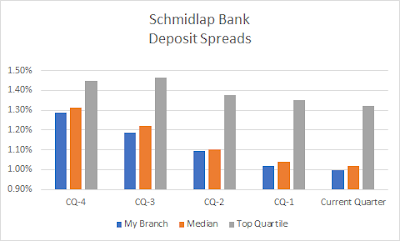
The head of retail, or the regional manager if a larger bank, can set the strategic goal for the Elm Street Branch (My Branch in the below chart) to achieve top quartile deposit spread in the branch network. 


Deposit spread is a key metric in any worthwhile branch profitability system. Understanding how deposit spread is calculated and how to impact it is easily taught and understood. I wasn't from the Finance function, and I once was a branch manager, and I understand it. In fact, I believe not using branch profitability because we don't think branch managers, regional managers, or even the head of retail/ small business banking will understand it is patronizing. Or quite possibly you've made these reports overly complex. Which is the enemy of effectiveness.

No, I think My Branch's goal of achieving top quartile deposit spread by some future period is specific, measurable, aggressive yet achievable (a quarter of your own branches achieve it), relevant (to the strategic objective), and time based (i.e. a SMART goal). 

After setting the strategic goal, and ensuring the branch manager understands how it is calculated and how to impact it, the regional manager can then empower the branch manager to develop a tactical plan to achieve it. Some may include dependencies, as many of the Chris Nichols' "7 Steps" require Marketing support. This support can be coordinated over the franchise, as in "how will Marketing help our branches achieve their goals?"

But this doesn't mean the branch manager can't highlight tactics to help the branch succeed, such as: 


1. Develop list of businesses within five miles of branch by NAICS code, cross reference with existing branch customers.

2. Focus on the most promising businesses' in industries where our bank can be successful competitively.

3. Perform competitor analysis using Amberoon tool (Step 3 in Chris Nichols article)

4. Leverage bank-developed and curated business-focused content to communicate with businesses identified in (2).

5. Branch manager/assistant branch manager to complete ABA Small Business Banker certification.

6. Implement business calling program as developed/instructed by [Internal training/ external consultant, etc.]


This, of course, is a summary list of strategic initiatives to achieve the goal that emanated from the whole bank's strategic objective to "achieve top quartile cost of funds with an emphasis on growing business deposits."

And if the bank is a learning organization, then each branch is empowered to experiment (within guidelines) to develop what works well, what must be refined, and what doesn't work. If the bank creates appropriate feedback loops, this can exponentially increase the effectiveness of strategic initiatives that are laser-focused on achieving the overall bank strategic objectives and vision. 

It is the very definition of rowing in the same direction. And it creates a culture where branch managers own their role in strategy execution, goal achievement, and the tactics to succeed. 

Have you experienced this level of ownership?


~ Jeff


Notes:

I mentioned that profitability reporting is a core competency of my firm. To learn more, click here


And please consider reading my book: Squared Away-How Can Bankers Succeed as Economic First Responders

Ten percent of author royalties go to K9sForWarriors.org, who work to bring down the suicide rate among our veterans. 

Kindle

Paperback

Hardcover

Thank you!


Thursday, December 17, 2020

The Bank Branch Manager's Wish List

Now is the time for wishes. And if I were a branch manager, given all of the demands on me, here is what I would wish for:


1. Clarity of Expectations. Do you want me, your branch manager, to grow small business customers by being a trusted advisor to small business owners within a five mile radius of the branch? Why don't you tell me?

2. Clarity on Accountabilities. If you know me, you would know that I am a big fan of making branch managers responsible for the continuous improvement of their branch's income statement. All other accountability schemes you might have in place are unnecessary unless the branch manager is on a performance improvement plan. Number of net new accounts? Why do you care if the branch continuously improves its profitability? Aggregate deposit growth? What if the branch manager doesn't grow deposits at all, but replaces maturing CDs with small business deposits, and grows small-ticket business loans?

3. Empowerment. Stop calling me about waived overdraft fees. So long as I own my branch's profitability, if knowing the unique customer's situation leads me to waive their fee, so be it. Do you know the customer's situation better than me? I know a waived fee reduces my profitability. I'll find it somewhere else.

4. Support. My favorite line from Grease: "If you can't be an athlete, at least be an athletic supporter." You know those nasty e-mails I get from operations because I didn't fill a Know Your Customer line- item out correctly? You might want to pay a visit to operations and give them a lesson on how the bank makes money. I'm not saying that I shouldn't be trained how to do it right. But sometimes the self-righteousness coming out of HQ demonstrates a profound misunderstanding about who drives profits... customers, and who serves customers... me. So create a culture of empathy and wanting to support people that have customers sitting across their desk.

5. Offload Operations. Do you really want me counting vault cash, reconciling daily branch capture, and servicing the ATM? Take inventory of operational duties given to branches. Yes, there will be people other than the branch manager that can execute on them, but the manual timecard checks, continuous hounding about BSA training, printing and signing forms then rescanning because nobody can use our imaging system as intended, is a bit much. Always, always look for ways to reduce operational duties of people that are the tip of the spear between bank and customer. 

6. Develop Me. I have no idea how to use the small business loan underwriting system. Our online account opening solution has no relation to how we open accounts in branches. So I can't help a customer when they call me from home wondering how to advance past a certain page. Merchant services? Nobody trained me on that. Small business cash flow management? Isn't that what you mentioned in Clarity of Expectations above? If you want me to be awesome at what you expect of me, help me get there. 


Because I want to be awesome. And so too, do your branch managers.


~ Jeff

Monday, June 11, 2018

Branch Talk

"The legacy [of build it and they will come] is an inefficient allocation of resources dedicated to supporting a less relevant delivery channel..."

So went an informative branch research report put out by my old friend and excellent bank stock analyst, Matt Schultheis of Boenning & Scattergood. At lunch recently, he said that the battle for retail deposits has already been won. Won by the national banks. It is a very similar point I made in an article to soon appear in a trade publication. 

With all of our hubris about how great community banking is compared to national banks, we are not winning market share from them. 

Here are some additional points I made to Matt via e-mail after I read his branch research piece. Edited for your clarity and context. All comments are my own, as his firm is a broker-dealer which would require a monumental amount of compliance review and disclosures. To wit, the research report actually used the term "Flavor Aid" instead of "Kool Aid" because it is likely a compliance person wouldn't let them use the obvious. #AddingValue


↭ __________________ ↭

Point 1: Pricing is becoming more transparent and I believe it will be increasingly difficult for banks to maintain deposit betas of 12 to 25, as [the research report] demonstrated in Exhibit 2. It is much easier now to switch from a local bank money market account to a Goldman Sachs Marcus account than last year, and it will be even easier next year.

That is why I suggest banks build a cost of funds advantage by 1) having a relatively higher proportion of non-interest bearing checking, and 2) a relatively higher proportion of "store of value" accounts like interest bearing checking and special purpose savings. I define store of value accounts as those where depositors are looking for safety and ease of use/access more than rate. Such as having a real estate taxes savings account.

Point 2: I am not sure deposit market share is the metric for branch success [as mentioned in the research report]. I believe it is branch deposit size, growth and spread delivered by those deposits. The challenge with the 3,000 square foot to a 1,500 square foot branch transformation is that larger branches tend to have more deposits.

A former bank CEO, responding to my questioning one of his branch's multi-million dollar expansion, said he got $40 million MORE in deposits when he did it. The math looks good in that context. Great actually.

Over and over we see these tiny, cutesy, 1,000 square foot branches maxing out at $20 million in deposits. I say put in a big branch and get $60 million, which is the average branch size in our profitability outsourcing service. The deposits per square foot calculation works out marvelously. Perhaps lease part of the branch to a CPA or a small insurance agency or something that tends to serve the same customers you are targeting to recoup some of the build-out and real estate taxes that come with a larger branch.


Point 3: You can "spoke" from the larger hub, as the research report suggests. And if your spoke maxes out at $15 million over a reasonable time, then close it and transfer those deposits to your hub. At an 80% retention rate, Charlie Sheen would call that #winning. Another strategy would be to measure the profitability of the hub/spoke region, rather than holding every individual branch accountable for spreads and profits. Although either is better than total deposit or number of accounts goals.


Point 4: The median direct expense of a branch as a percent of deposits in our profitability database is 98 basis points. That's 98 basis points that a branch bank can't pay in interest to their depositors that Ally Bank can pay. Perhaps that's overly simplistic as Ally has elevated digital expenses, low pull-through rates, and higher back office expenses because they have no branches.

But let's say that accounts for 20 basis points on the margin. Still a 78 basis point beta. Banks have to figure out how to sell the advantage of their branch network, which by the way survey after survey says customers want, and figure out a way to lower the 98 basis points direct expense of branches or support center expenses. Preferably both in order to lower that 78 basis points. Because customers won't accept that size of a haircut for the convenience of having a branch. But I believe they will accept some haircut.

By the way, the 98 basis points direct expense is off of a $60 million average branch deposit size. That means it costs ~ $588k in direct operating expense to run a branch. If you go with a wee-little branch, perhaps you shave off $150k of that. If that branch maxes at $20 million, then your branch direct expense of the "branch of the future" is 2.17% of deposits, versus 98 basis points for the "branch of today". Which is better?

                                                        ↭ __________________ ↭


Thought you might enjoy our exchange.


~ Jeff


Sunday, September 10, 2017

Bankers: Five Ways to Use Profitability Data to Move You Forward

Accountability is a dirty word. It evokes images of finger wagging, stern looks, and sheepish floor staring. I'm sure at one point of the word's evolution it wasn't this way. Words and phrases earn their reputation by those that use and receive them. In banking, it is what we made it to be.

On a recent Pennsylvania Institute of CPA podcast, Bob Kafafian from my firm was asked how to use management information. Bob's response resulted in a follow-up question by a Midwest banker friend of mine. 

And since I am scheduled to speak about it at a Financial Managers Society breakfast tomorrow, I'll answer it.

Here are my ideas on how to use Management Information to create a positive accountability culture.

1. Hold branch managers accountable for revenue growth. Revenue growth equals deposit spread (coterminous using funds transfer pricing, or FTP), loan spread less provision (for loans that the branch is responsible for generating), and fee income. Imagine if Wells Fargo branch managers were accountable for this, instead of number of accounts per customer. Fake accounts with little or no balance generate little or no spread. But draws operating expenses from support centers. Imagine if your branch managers were accountable for this instead of deposit dollar growth. Would you be getting that desperate phone call asking for a rate exception to keep the money at the bank?

2.  Hold lenders accountable for their portfolio ROE. You read it right. That's an "E", not an "A".
Lending is a risk business, and aside from the provision expense, and net-charge off rate, those loans require equity to support them. If you allocate equity by product based on your institution's risk experience, then you know how much equity your institution requires. It should be part of your capital plan. Drill that down to the loan level, you can create ROE hurdles when lenders price loans, and measure their pre-tax ROE on their entire portfolio using the coterminous spread, less provision expense, less operating expense per loan type, to calculate the lenders' actual ROE for their portfolio. Imagine!

3. Hold support centers accountable for a decreasing relative cost per balance sheet category. If measuring a deposit operations department, then the operating expense from deposit operations as a
percent of deposit balances should decline long-term in a growing institution. It is the very definition of economies of scale. Notice I say long-term, because you don't want to defer investment in personnel or technology in fear of causing an upward blip in your trend. That's managing by budget that has caused executives to reduce innovation so they can make their budget.

4. Rank. Nothing should be more motivating than ranking branches, lenders, and support managers in achieving their goals as measured by Management Information than seeing where they rank among their peers. Including a ranking report of your twenty branches by revenue growth, and profitability,  in a sales meeting should put smiles on the faces of those at the top, and a look of determination on the faces of those wanting to get there.

5. Reward. Incentivize your personnel for achievement. Let's turn that frown upside down when we talk of accountability. Deposit Operations costing 16 basis points of deposits three years ago, and 12 basis points today, is an achievement that should be recognized by the entire institution. The same for ROE improvement for lenders, or pre-tax profit improvement by branch managers. Let's not foster a culture of fear, recrimination, and public floggings. Let's raise up our achievers!


I frequently speak of financial institutions' over-investment in under performing branches. Those investments of our precious operating expense dollars could be used in more promising areas. Instead, we limit resources to the very things that could lead us to a more sustainable future. Using profitability information to incentivize the right behavior will create a culture of achievement, and help us make more efficient decisions to better serve customers, reward employees, and improve performance. 

How do you use Management Information to run your bank?

~ Jeff


Note: This is my personal blog and I mostly refrain from direct sales pitches. But since I firmly believe 1) every financial institution should do this, and 2) few have the resources to do this, I offer this...

My firm, The Kafafian Group, does profitability reporting on an outsourced basis because we recognize the challenge community financial institutions face in building their own model, and running it quarter after quarter. If interested, call Gregg Wagner, our practice leader, at 973-299-0200 x114 or reach him at gwagner@kafafiangroup.com. 


Saturday, October 29, 2016

Five Challenges to Your Bank of the Future and Ideas to Overcome Them

I recently spoke at a Financial Managers' Society (FMS) breakfast meeting on this subject and thought I would share my comments with you.

With all of our anguish, torment, debate, and deliberation about the future of our country, our industry, and our bank, here are some common themes that I have been seeing that can be improved should bank management commit to making them happen.

Forget the things outside of your control. These five themes are firmly within your ability to make a positive impact on your future.

1. We merge, citing economies of scale, but fail to realize them. In 2006, when the median asset size within my firm's profitability outsourcing service was $696 million, the operating cost per business checking account was $586 per year. In 2016, the median sized financial institution is $1.1 billion, and the operating cost per business checking account is $710. In other words, the financial institutions grew, and the cost per account grew. This is the theme across nearly every product category. Don't believe me, check your banks' expense ratio (operating expense/average assets) or efficiency ratio as you grew.

Idea: Create measurable incentives to support centers to provide more efficient support to profit centers and for risk mitigation. For example, deposit operations' expense as a percent of deposits should decline as the bank grows. Loan servicing expense as a percent of the loan portfolio should do the same. 


2. We over-invest in under-performing branches. I recently mentioned to a community bank management team that community financial institutions are slower to close branches because their decision making goes beyond the spreadsheet and market potential. Community bankers know the town mayor, and key business leaders. So they worry about other things that go beyond the fact that their branch in that market has little chance of being profitable. But allowing branches to operate at losses takes resources away from areas that need immediate resources, such as technology acquisition and deployment.

Idea: Develop objective analyses for entering markets. If the branch does not meet profit objectives within a reasonable period represented in the original analysis to open it, close it. Make it near-automatic.


3. Our brand awareness and customer acquisition strategy is moving at a turtle's pace, not the hare pace of the industry. In my firm's most recent podcast, we discussed the recently released FDIC Summary of Deposits data that showed, with all of the negative press surrounding large financial institutions, FDIC-insured banks with greater than $10 billion in assets moved from an 80.6% deposit market share in 2012 to an 80.7% today. This phenomenon was brought home when a banker told me that, in the Philly suburbs, Ally Bank was the most recognizable banking brand. Aren't they still owned by our government? 

Idea: Develop a clear message on what your bank represents and align your culture, and all sales and marketing channels to deliver your value proposition. 


4. We embrace complexity when we should be seeking simplicity. The decline in defined benefit pension plans combined with the increases in defined contribution (401k) plans, the abysmally low US savings rate (31% of non-retired people have no retirement savings), and the increasing complexity of running family and business finances presents an opportunity for community financial institutions to make their customers' lives simpler. We should start with ourselves. For example, when onboarding a customer, an FI can perform needs assessments, risk assessments (needed for risk management purposes), and customer capital allocation needs all at once, and add value to the customer relationship. 

Idea: At account opening, build an automated business process that includes the needed Q&A to assess customer needs that spurs post-account opening follow up, know-your-customer information, and risk assessments required to risk rate customers that assigns a rating that drives capital allocations to that customers' balances and rolls up to determine the bank's capital requirements.


5. We under-invest in the people that can build our bank. Because of over-investment in areas such as regulation and unprofitable branches, we under-invest in elevating the abilities of our employees to serve as advisers to customers, as highlighted above. Also, we tend to buy key people on the street, such as commercial lenders, rather than raising them within our bank, because of the time and resource investment needed to turn junior level people into productive commercial lenders.

Idea: Build a bankwide university that includes on-the-job training, web-based seminars, in-person training, and banking schools to create career paths for junior-level people that will reduce our need to buy senior-level people on the street, and elevate the skill sets of employees to actually advise customers, rather than only sell to them.


If I were to end this post with a theme, it would be urgency. We are past the time to lament about the interest rate and economic environment, and Dodd-Frank. They are outside of our control.

We are intuitively aware of the above challenges. The good news is we can do something about them. Address them this year, this month... no, this week! And your bank will move forward to an independent future for your employees, customers, and community. 


Did I miss any challenges within our control?


~ Jeff


Sunday, October 09, 2016

Evolution of Banking: Three Slam Dunk Predictions

The sheer number of strategic initiatives and technologies in the banking industry makes it very difficult to predict outcomes with any certainty. Not that me or other industry pundits don’t try.

I have been noticing some trends that are providing insights on our direction, evolution, and ultimate picture of our future.

Future Picture was coined by the US Military for defining flight mission success, and was brought to business prominence in Air Force pilot James D. Murphy's 2005 book, Flawless Execution.  Using his example of envisioning what success would look like, a bank’s Future Picture should be a detailed description of successful execution of strategy. I challenge bankers’ to describe their Future Picture.

It can be highly subjective and difficult, particularly in an era of unprecedented change. But I would like to share three strategic directions where the train has either left the station, or is boarding.

1. Branches must be larger to survive. According to my firm’s profitability database, branches generated revenue (defined as consumer loan spreads, deposit spreads, and fees) as a percent of branch deposits of 3.50% in 2006. Today, that number is 2.08% due to the interest rate environment, the regulatory environment (reducing deposit fees), and customer behavioral changes. Therefore, the average deposit size of branches grew, to over $60 million at the end of 2015 (see chart). This trend is not likely to change, as bankers are more apt to prune their network and increase overall branch profitability. And the customer. Don’t forget them. They use branches less, although many still identify branch location as important to bank selection.


2.  Technology expenditures will grow faster than overall expenditures. I recently performed this analysis for a client, identifying the “Data Processing” expense as a percent of total operating expenses for all FDIC insured banks as identified in their call report. Surprisingly, it represented only 4% of total operating expense.  Note this excludes IT personnel expense. But the number is growing faster than overall operating expense (see chart), meaning that IT expense is becoming a larger proportion of operating expense. It is disappointing that this trend is slowing so banks can meet their budgets and profit objectives, regressing back to old habits of cutting IT projects to make budget. But overall, banks are seriously evaluating technology to improve efficiencies and their clients’ banking experience.


3.   Robotics are coming. It was only recently I began to believe this. But there are opportunities being evaluated and implemented to automate repetitive processes to reduce overall costs, minimize risk, and speed the process. A couple examples where automation and/or robotics are ripe to improve processes include reviewing remote deposit checks, currently eye-balled by humans. Not scalable. The x-point evaluation could more quickly and effectively be accomplished by a robot. Another area where automation is coming is BSA case evaluation, where the bank’s BSA application identifies potentially high-risk client activity and a program goes through several standardized checks to clear the case or elevate it for human intervention, reducing the overall number of cases needing human review.


These aren’t the only changes. Just the ones that I believe are coming, no matter who tries to stop them.

So why try to stop them?

~ Jeff

Tuesday, December 01, 2015

How About Profits in the Branch of the Future?

“[Sample] Bank has reinvented banking with the opening of the [Branch of the Future]. To experience the future of banking today, simply step across the threshold.” So went the 2012 press release announcing the opening of the next generation of the bank branch.

At June 30, 2014, that branch had $23 million in total deposits, down $1 million from one year ago. The branch of the future concept was not enough to inspire customers to open accounts in droves while sipping coffee and surfing the net.

Branch demand and utilization by customers is changing rapidly, and there is no shortage of opinions on the look and feel of the branch of the future. I recently read an article about Poland’s mBank that is designing kiosk and light branches to complement their traditional branch network (see photo). 

The smaller branch concept gets significant play in professional publications. But let’s not forget that we have past experiences with a “light branch”; namely the declining in-store branches. These branches were notorious for being low-balance transaction-oriented branches that did not enjoy great success.

From first-hand experience training in an in-store branch, I found it difficult to attract higher balance and small business customers, significant contributors to branch balances and therefore profits. This highlights an important banking concept: revenues are mostly driven off of balances, not activity. 

mBank’s light branch depicted above is located in a mall. Malls are experiencing difficulty in the United States, as millennials opt for smaller, urban environments to shop. And the rest of us are increasingly buying online. So putting a light branch in a mall that is being vacated by Macy’s may not be a winning strategy if your bank’s objective is to increase visibility through strategically located, yet smaller branches. 

All talk of visibility and foot traffic aside, the measure of branch success should be profits. In the chart below, derived from The Kafafian Group’s (TKG) peer database of hundreds of community bank branches, we see that the revenue generated from deposit spreads, asset spreads (typically consumer loans), and fees (typically deposit fees) as a percent of branch deposits averaged 2.08% for commercial banks and 1.88% for thrifts during 2014. This is down from 4.17% for banks and 2.51% for thrifts in 2006. So if your “light branch” has $23 million in average deposits, as our “branch of the future” example above does, then it generates $478,400 in annual revenue, on average. Not very inspiring. 

Since 2006, community banks have recognized the need for greater balances in branches to improve profitability. See the next chart for average branch deposit size trend from the TKG database. Interestingly, the average branch deposit size for thrifts declined. This phenomenon is largely attributable to the 2008 recession and the ensuing drop in loan demand which allowed thrifts to run off their high rate CDs. But since that drop-off, the increase in average branch deposits can be attributed to: 1) deposit growth without the commensurate growth in branches, and 2) pruning branch networks without significant deposit attrition.
Branch deposit growth combined with reviews of transaction activity to reduce branch personnel has buttressed the decline in deposit spreads and fees, and branch profitability. But not to the point of the profits enjoyed by branches in 2006, which was approximately 2.73%, compared to 0.86% in 2014. These pre-tax profit ratios are a percent of average branch deposits, and excludes indirect branch operating expense such as Deposit Operations and IT, and overhead such as Executive and Finance. Not only are branches not supporting the army of support aligned behind them, they are barely supporting themselves. 

I have written and spoken about accountability for branch profitability. Accountability gets a bad wrap. It can convey pressure, discipline, and failure. Applied correctly, accountability could promote focused effort, rewards (financial and non-financial), and triumph. 

Imagine holding branch managers accountable for increasing deposit and loan spreads, and generating direct pre-tax profits. Those that rank as top tier performers receive meaningful incentive compensation and recognition. Branch administrators charged with the profitability of the branch network won’t fear pulling the plug on profit laggards, because they are dragging down the profits of the whole. Who cares if a director drives by the unprofitable branch every day? 

Branch of the future discussions would focus less on design and “gut” feel, and more on profit potential and profit drivers such as demographics, visibility, personnel, deposit growth, the experiences of other profitable branches in your network, and how this aligns with bank strategy. Not how many Keurig cups were consumed last month. 

It is possible to view branch profitability in market clusters, if the cohesiveness of a community spans multiple towns. One branch may be a laggard, but its presence is critical to the success of the whole. 

It is also possible to build large branches that are successful. If a large, marquis-like branch costs $700,000 per year to run, yet has $80 million in deposits with our aforementioned revenues as a percent of deposits of 2.08%, isn’t it better than our branch of the future mentioned above that has $23 million? 

Using profitability as your measuring stick likely will eliminate rationalization to keep underperforming branches open. I hear arguments about poor performing branches being critical to a market area. To which I would ask the logical question, “what market area”? Let’s compare to other market area profits. Does the rationalization hold water? 

Constant evaluation of branching, a little growth here, a little pruning there, will be essential to effective deployment of your bank’s limited resources available to remain relevant. To keep your best performing branches and to motivate your best performing people, branch profitability can be an effective tool to make the right decisions in our rapidly changing industry.


~ Jeff


Note: The above article first appeared in the March-April 2015 edition of paBanker Magazine, a publication of the Pennsylvania Bankers Association.