Thursday, February 24, 2022

Things I Wish Bankers Did Better: Project Management

PPP urgency must be our norm.

On September 17, 2021 in the Scottsdale, Arizona desert, I delivered a speech to a ballroom full of bankers titled: 5 Things I Wish We Did Better. It was well received and was recently picked up by a banking school as an elective class.

Number 1 on that list: Project Management. I used the embedded commercial as indicative of the life span of a project at a community bank. In my presentation, I estimated the following: Time to identify high lifetime value customer segments to uncover their demands, 4 months; Actually uncovering their demands and solutions providers, 4 months; Select the solution, 4 months; Implement the solution, 6 months. That's a year and a half for those counting.


And my observation was validated at a recent bank strategic planning retreat where the strategy team said solutions contracts that they signed last year will be lucky to be implemented by the end of this year. Their experience is consistent with my observation.

This, in my opinion, is an existential threat to the relevance and survival of community banking. We have to be able to identify, implement, utilize and market technology solutions using PPP-level speed and urgency.


Can it be done? At Bank Director's Acquire or Be Acquired conference, Anthony Morris from nCino, in a Transformation Through Technology panel, gave a sample timeline of project implementation (time to implement) of four months, followed by a time to value (time from implementation until the solution adds value) of an additional two to three months.

I thought he was being wildly optimistic.

But Jill Castilla of Citizens Bank of Edmond told me that it took her community bank 10 days from idea to implementation for PPP.Bank, which was a critical tool in the early, wild-west days of the first wave of PPP loans. Ten days. Her bank at the time was just over $300 million in total assets and she had 56 FTEs. 

Mike Butler, CEO of Grasshopper Bank, thinks rapid tech integration shouldn't be anomalous. Mike has a history of getting solutions quickly from idea, to implementation, to time-to-value in his prior life as CEO of Radius Bank (acquired by LendingClub) and now at Grasshopper. They changed their core in four months! They contracted with a vendor for online account opening in November and are flipping the "on" switch this month. What's their secret sauce, according to Mike?

- Hire a rock star CTO, which he doesn't believe is the norm in community banking. He didn't define what he meant, but in my mind I think a rock star CTO does not allow hurdles, either erected by solutions providers or internal naysayers, to slow down the bank from its current state to its desired one. A rock star CTO is a plow driver, not a caution cone erector.

- Have a killer project management team inside the bank.

- Use the API concept to circumvent the fortress that cores build around their solution. This likely requires you to have the traditional core middleware that they will charge you for, but it avoids getting on the "we'll get back to you based on your size and how busy we are" attitude that community banks suffer as a result of core dependency.

- Don't try to boil the ocean. Use the MVP concept (minimum viable product) and GO! Solve one specific problem at a time rather than trying to solve multiple or all problems. Don't wait until perfection to launch. Launch and learn, make course corrections.


Linda Stahl, Chief Revenue Officer of Paladinfs, herself a recovering core provider veteran, thinks core dependency is getting worse, citing that it used to take 80 days on average to negotiate a core contract. And it's now taking 180 days on average. Once under contract, the time to convert is about nine months. The future, in her estimation, is that the core will serve as the record keeping solution, and we will use API based plug and play based on a bank's needs. But we're not there yet. We still require the core middleware as a bridge to the future, which an estimated half of all banks do, and cores charge tolls for access to your data. 

To navigate from now until a future, API-based plug and play state, Linda suggests building into your technology contracts specific service level agreements (SLAs) that have progressively sharper teeth. SLAs should essentially be a statement of work with milestones. If the technology solution doesn't meet the first or second milestone, there is a financial penalty such as credits or an outright cash payment. If it escalates to missing the third or fourth SLA, the bank can terminate the contract without penalty. Mike Butler suggests discipline in enforcing technology solution SLAs. Have some gumption. Although he used a more colorful word than gumption.


This week I noticed that my large financial institution had been charging me $15 per month for an account I used to pay my 23yo's college bills because I must have blown through their minimum balance as her college days neared the end. A tech-forward, trust-based financial institution that spends billions per year on technology should have sent notice to me or some relationship manager that this was happening. But no, I found out by accident a year after it started. If we think because our largest competitors that frequently brag about their tech spend are squared away, think again. 

A key strength a community bank has over those large institutions that dominate market share is we can act quickly. The context of the strength is in decision making or making strategic pivots. This strength should not exclude tech implementation. And it is in tech project management where we need to significantly improve.


~ Jeff


Please consider reading my book: Squared Away-How Can Bankers Succeed as Economic First Responders. 

Ten percent of author royalties go to K9sForWarriors.org, who work to bring down the suicide rate among our veterans. 

Kindle

Paperback

Hardcover

Thank you!


Saturday, January 15, 2022

Four Leadership Lessons Learned from St. Paul's Crusaders

Leadership is taking limited information and striking down a path with the commitment needed to succeed in the endeavor. It is motivating others to follow you into uncertainty, while maximizing their ability to contribute to success. It is filling each teammates emotional tank so they self-motivate to maximize their strengths and contribute to the team. 

I moderated a strategic planning retreat where bankers were debating employee development. A senior manager quipped about "coaching." The CEO asked, "do we really coach?" "I'm reading a book by Bill Cowher (former Pittsburgh Steelers head coach), and we don't do what Cowher has done."

Coaching sports is a highly accountable form of leadership. Are you maximizing the talents of individual team members? Are you improving how they work together to create a high functioning team? In sports, the results are on the board. Wins and losses. Statistics for nearly every function. In my book, Squared Away: How Can Bankers Succeed as Economic First Responders, I told how the Positive Coaching Alliance helped me become a better girls lacrosse coach, and as a result, a better leader.

The banker's comments on Coach Cowher got me thinking about coaches in my life and what they taught me about leadership. Two such underappreciated coaches were Coach McLaughlin and Coach Hewitt from my middle school basketball team: St. Paul's Crusaders in Scranton, Pennsylvania.


St. Paul's

First, a little background. Most people that grew up in Scranton when I did were Catholic. And the middle school Catholic basketball league was highly competitive. St. Paul's usually fielded an excellent team, as was the case in 1979-80. 


I was an average player at best. A couple notches down the bench from our best. But I had some skill and probably more potential. But my attitude got in the way. I could have been a better player. But I thought the effort wasn't worth it because I was, shall I say, in a different economic situation than most of my teammates. My father passed away when I was young. Most of my teammates had both parents, and were more affluent than me and my family. I was fortunate to receive discounted tuition so I could attend the school. My mother told me that my father, prior to his death, asked her to keep us in Catholic school as long as she was able. 

This situation resulted in a chip on my shoulder that impacted my attitude, and therefore my effort. Why put forth what it will take to hone my skills only to see the privileged kids get the playing time anyway? This attitude manifested itself when a player brought up from the 7th grade team started getting more playing time than me. I promptly quit.

I was deep in the victim rabbit hole.

But my coaches wouldn't let me go. Although, looking back at it with open eyes, they should have. My bad attitude was impacting other players. My biggest regret from 8th grade basketball was not my attitude and effort, and the ease that I painted myself a victim (although both were lamentable); it was that I influenced others to share my victimhood. 


Lessons Learned

What did I learn from Coaches McLaughlin and Hewitt that are instructive for us as leaders?


1.  Think Big Picture. I was what is currently termed an "at-risk" kid. I was in a single parent household where the parent worked and my choices would have a big impact on the direction of my life. I didn't know this. I was 14! But my coaches did. If they allowed me to quit, how would I spend that newfound time? And how could they influence the direction I took? In other words, how could they coach me? If you are challenged by team members with a bad attitude that impacts their effort and performance, think about how you can positively impact that person's trajectory and be a transformational person in their lives. I'm not suggesting tolerating or ignoring the attitude issue, but tackle it in such a manner that makes them better and a team contributor. 


2.  Reward great attitude and effort consistently. As my attitude worsened, and my effort slipped, it opened the door for another player, likely without as much talent and potential as me (although it is difficult to self-evaluate), to get more playing time. This is exactly what happened at St. Paul's. My sulking on the bench led to another player's opportunity. He had a great attitude and worked really hard in practice. In fact, his hard work actually served as part of my rehabilitation. How can I slack while this kid is working it? The coaches rewarded him with more playing time for his attitude and effort. Even at 14, I realized it. And he deserved it. That kid went on to be a positive contributor to his high school basketball team.


3.  Learn the "Why". What if my coaches viewed me without context? Me quitting should have been accompanied by them muttering "good riddance." In my dark days of victimhood I was a detriment to the team. I was negatively impacting other players, my teammates, my friends! It would have been a very bad day for the direction of my life if my coaches had no context to my situation and what was driving my attitude. They took some lumps from me. They were stern when they needed to be. More so with me because of where I was, my behavior, and my situation. Short term I might have thought their treatment of me was relating to my economic and family situation. In retrospect, they understood my situation and tried to be the coach that I needed at that time. Each person needs something different from their leaders. It is the leaders' job to find out the "why" and approach the relationship from that context.


4.  Communicate! In a 2013 article, Lead Like Lincoln, I highlighted communication as one of our former president's greatest leadership traits. During the Civil War, I doubt any of the top generals asked themselves "I wonder where Lincoln would stand on this?" He used to communicate directly with his generals so there was no doubt where he stood on the big issues. Communication is a two way street. As the saying goes, you have one mouth, two ears. Active listening is important. When communicating with a 14 year old, my coaches not only had to listen to what I was saying, but the nuances as to what I was meaning. I certainly wouldn't come straight out and say "Why bother trying? The privileged kid has my position locked down." Classic don't try-can't fail. Even to someone my age, that would sound petty. So my coaches communicated what they were doing, and my role in it. This probably brought me back from the brink on that day that I handed in my uniform. I realized what they wanted and my role in it. They understood my attitude, and eventually I learned the basis for my attitude was wrong.


I got over it. Although it took time, and was a process not an event. By the time I crawled out of the victim rabbit hole I was no longer in middle school. So perhaps my coaches never knew the impact they had on me. But it was profound. And I have been a crusader against painting myself a victim ever since. And I credit the transformational leaders that helped me on the journey.


Thank you Coach McLaughlin and Coach Hewitt!


~ Jeff


Friday, January 07, 2022

Jeff For Banks: Top Five Posts of 2021

I don't expect followers of my blog to read every post. And my blog page shows the top five posts of all time. In fact, the content in my book, Squared Away: How Can Bankers Succeed as Economic First Responders, was driven by the top 20 most-read posts of all time.

But what about recently? Here are the top five most-read posts of 2021. In case you want to read them.


1. The Death of the Community Bank

Pundits make predictions. And I jumped in with both feet with a presentation I made in 2008. When I dug it out of my archives, I reviewed those past predictions with what actually happened. Where was I right? Where was I wrong?


2. CFPB: Are They Coming To Get You?

Written in March in response to questions a bank trade association CEO asked me as he was penning an Op-Ed, I did not know how prescient this piece would be. The questions were relating to the CFPB director contemplating taking "aggressive action" against those that were perceived to engage in Covid relief violations. Well that turned out to be the first piece of popcorn on the trail of a far more aggressive CFPB that is likely to get the majority of good banks sucked into the vortex with the few bad ones.


3. Squared Away: How It Happened

Since I had never published a book, I had no idea how to approach writing a book. Perhaps many of my readers are contemplating putting pen to paper and sharing what they've learned with a larger audience. And this drew them to how it came about for me. Hint: It wasn't all sunshine and rainbows. It took discipline. Except for the title. That was a family fun brainstorming session.


4. Memorial Day: Remember Maurice "Maury" Hukill

One thing I have learned about community bankers is they truly appreciate the sacrifices others made that allowed them to pursue a career in community banking. I highlight a fallen service member every Memorial Day. And this one had the most views of all of them. Perhaps it was boosted because Maury was a native of my hometown, and I pushed this out to my Facebook friends too. So there were probably a bunch of views that were not bankers. But still, I salute you, my readers, for elevating this tribute.


5. Bankers: Seven Questions to Determine if You Have a Strategic CFO

The consulting firm Deloitte posited seven questions to determine if the reader was (if he/she was a CFO) or has a strategic CFO. I posted the questions, provided the Deloitte meaning, and then connected it to banking. I hope you or your CFO fit the bill.


My Pick

Probably because it was such an important and high-level issue, Banking's Execution Imperative was my favorite. Although it did not take home Top 5 hardware. I rarely see bankers determine their strategy willy-nilly. Instead they put in the effort. Get executives and the Board involved. Dig through data to come up with the best strategy for their bank, in their current situation. And a year later when we follow up on progress, we hear about their "day job." If you're an executive, strategy development and execution is your day job. 


Honorable Mention

Although this post was published in November 2020, it still had enough legs to be one of the top read of 2021. Dorothy has been a mainstay of our blog. She had been writing her commentary for some years for physical distribution to her bank's customers. Finally, the Marketing Department was on to her and began posting directly to the bank's website. She'll be missed on these pages. But you can catch her on our next This Month in Banking podcast waxing eloquent on what bankers should do in this uncertain interest rate environment. That release date is January 26th. Get it here or wherever you get your podcasts.


Thank you to all of my readers. I don't take you for granted and will continue to be thoughtful in how I, and my colleagues at The Kafafian Group, can bring value to you and your teams. WE WANT YOU, YOUR EMPLOYEES, CUSTOMERS, COMMUNITIES AND SHARHOLDERS TO WIN!


~ Jeff


Wednesday, December 29, 2021

Banking's Top 5 Total Return to Shareholders: 2021 Edition


For the past decade I searched for the Top 5 financial institutions in five-year total return to shareholders because I support long-term strategic decision making that may not benefit next quarter's or even next year's earnings. And I am weary of the persistent "get big or get out" mentality of many industry pundits. If their platitudes about scale are correct, then the largest FIs should logically demonstrate better shareholder returns, right?

Not so over the ten years I have been keeping track. The first bank to crack the Top 5 over $50 billion did so last year. As a reference, the best SIFI bank in five year total return was Bank of America at 26th overall. 

My method was to search for the best banks based on total return to shareholders over the past five years. I chose five years because banks that focus on year over year returns tend to cut strategic investments come budget time, which hurts their market position, earnings power, and future relevance than those that make those investments. Short-term focus is a common trait of banks that focus on shareholder primacy over stakeholder primacy.

Total return includes two components: capital appreciation and dividends. However, to exclude trading inefficiencies associated with illiquidity, I filtered out those FIs that trade less than 2,000 shares per day. This, naturally, eliminated many of the smaller, illiquid FIs. I also filtered for anomalies such as recent merger announcements as a seller, turnaround situations (losses suffered from 2016 forward), mutual-to-stock conversions, stock dividends/splits without price adjustments, and penny stocks. 

As a point of reference, the S&P US BMI Bank Total Return Index for the five years ended December 27, 2021 was 60.4%.

Before we begin and for comparison purposes, here are last year's top five, as measured in December 2020:

#1.  Silvergate Capital Corporation (NYSE: SI)
#2.  Live Oak Bancshares, Inc. (Nasdaq: LOB)
#3.  Fidelity D&D Bancorp, Inc. (Nasdaq: FDBC)
#4.  Silicon Valley Financial Group (Nasdaq: SIVB)
#5.  Bank First Corporation (Nasdaq: BFC)


Here is this year's list:


Here we are again. The first crypto currency bank to crack the Top 5 has landed the top position two years running, delivering a 1,257% 5-year total return. You read that right. Silvergate had $150 million in total revenue over the past twelve months, and has a market capitalization of $4.7 billion, or 31.4x revenues. It's five-year compound annual growth rate ("CAGR") in earnings per share was a very strong 27.2% (actually 5.75 years starting full-year 2016 ending LTM 9/30/21). It's Price/LTM EPS is 57x. Investors must be expecting much faster earnings growth to earn the valuation this bank currently enjoys. Average digital currency customer deposits were $11.2 billion at September 30, 2021. 
Silvergate also facilitates payments between crypto exchanges via its Silvergate Exchange Network, or SEN. It's current performance for the LTM ended September 30, 2021 was a 0.78% ROA and 10.04% ROE, which doesn't merit the valuation, so growth and greater profitability must be what investors see. Here is Silvergate CEO Alan Lane after third quarter earnings announcement on CNBC. Give Silvergate credit, they picked a niche and are executing on it to the delight of investors. Crypto is blazing hot!


#2. MetroCity Bankshares, Inc. (Nasdaq: MCBS)


MetroCity Bankshares, Inc., and it's banking subsidiary Metro City Bank are headquartered in Atlanta. The bank was founded in 2006 and operates 19 full-service branch locations in multi-ethnic communities in Alabama, Florida, Georgia, New York, New Jersey, Texas and Virginia. Quite the geographic expanse, but not uncommon for ethnic banks. What is unique is, after reviewing the management team and board, there are people of Korean, Malaysian, Indian, and Chinese descent in leadership positions. At least that is what I can tell from the bios. The bank has grown over $1 billion in assets over the last twelve months, from $1.7 billion at September 30, 2020 to $2.8 billion at September 30, 2021. This was fueled mainly with loan growth. No acquisitions during this period. MCBS, with a market cap of $705 million, and LTM revenues (net interest income plus fee income) of $125.5 million, trades at 5.6x revenues. And it had an eye popping LTM ROA of 2.49% and ROE of 21.3%. We see these numbers from heavy SBA or, more recently, heavy residential mortgage producers. And for sure, MCBS is both, but it looks like they have been booking their residential mortgages, showing no YTD gain on sale from their residential mortgage loan production. Given that residential mortgages make up 73% of their loan portfolio, and their yield on loans was 5.16%, it makes me think they do a significant volume of non-conforming loans. But still, they have delivered a five-year total return of 439%! Well done!


#3. Triumph Bancorp, Inc. (Nasdaq: TBK)


Triumph Bancorp, and it's subsidiary TBK Bank, SSB were founded in Dallas, Texas in 1981 and provides commercial and consumer banking products focused on meeting client needs in Texas, Colorado, Kansas, New Mexico, Iowa and Illinois. Triumph also serves a national client base with carrier payment solutions through TriumphPay, invoice factoring through Advance Business Capital LLC d/b/a Triumph Business Capital, insurance through Triumph Insurance Group, Inc. and equipment lending and asset based lending through Triumph Commercial Finance. Phew! Needless to say, they have diverse revenue streams and geographies, which produced a LTM net interest margin of 6.35%, driving an ROA/ROE of 1.98% / 15.42%. Profit numbers were aided by an allowance recapture. You would think such a margin would come with higher non-performing assets to total assets but no, as NPAs/Assets were 30 basis points at September 30th. The bank has nearly doubled in size in the past five years, aided by three whole-bank and one multi-branch acquisition. But during that span they delivered a 375% total return to shareholders. Wow!


#4. Live Oak Bancshares, Inc. (Nasdaq: LOB)

After being conspicuously absent from prior JFB Top Fives, LOB makes it's second showing in a row.  It has been an industry darling due to its dedication to technology experimentation. It was the brain child for the nCino platform, which it formed in 2012 and spun off in 2014. Live Oak was founded in 2007 to provide business loans, primarily Small Business Administration (SBA) guaranteed loans, to select industries, like dentists and veterinarians. Live Oak is now the largest SBA 7(a) lender in the United States. They opened in 2007! But it goes beyond traditional banking. Subsidiaries, in addition to the bank, include: Live Oak Private Wealth, LLC, a registered investment advisor; Canapi Advisors, LLC that provides investment advisory services to new funds focused on providing venture capital to new and emerging fintechs; Live Oak Ventures, Inc. that invests in businesses that align with the company's focus on fintech; Government Loan Solutions, Inc., a management and technology consulting firm that engages in the settlement accounting, and securitization process for SBA and USDA guaranteed loans; and, get this, Live Oak Grove, LLC, which is their on-site restaurant for employees in Wilmington, North Carolina. It's five year total return: 371%! Well done!


#5. SVB Financial Group (Nasdaq: SIVB)


SVB Financial Group, formerly Silicon Valley Financial Group is the parent company of Silicon Valley Bank, long considered a go-to bank for startups. At $191 billion in total assets, SVB remains the largest financial institution to ever break into the Top 5 Total Return to Shareholders. It's going to be difficult to describe what they do in summary. But here I go. They are a diversified financial services company that operates through four segments: Global Commercial Bank, which provides traditional banking services plus some not so traditional like mezzanine lending, acquisition, finance, and corporate working capital facilities, foreign exchange, export/import and standby letters of credit, vineyard development loans, and on and on I could go. SVB Private Bank segment offers traditional private banking and wealth services. The SVB Capital segment provides venture capital investment services that manage funds on behalf of third party limited partner investors. SVB Leerink segment engages in capital markets activities, M&A, and investment banking services. SVB operates through 30 offices in the USA, Canada, UK, Israel, Germany, Denmark, India, Hong Kong, and China. It was founded in 1983. It's largest acquisition in the last five years was Boston Private Holdings, but it has been active in its other segments, including the acquisition of Leerink. It has a LTM ROA of 1.50%, and an ROE of 19.91%. Even at it's relatively large size and battling the law of large numbers, SVB remains known for it's niche in the venture capital and founders space. It's not easy to fight "general bank", but they seem to be doing it. And delivered a 296% five-year total return!  Nice!


There you have it! The JFB Top 5 all stars. As in all prior years, no SIFI banks on the list. Increasingly on the list, though, are niche financial institutions that are making strategic bets that are being rewarded by their shareholders in the form of higher valuations. In fact, all on the list are niche financial institutions. #Instructive

Congratulations to all of the above that developed a specific strategy and is clearly executing well. Your shareholders have been rewarded!


~ Jeff


Note: I make no investment recommendations in my blog. Please do not claim to invest in any security based on what you read here. You should make your own decisions in that regard. FINRA makes people take a test to ensure they know what they are doing before recommending securities. I'm sure that strategy works well.


And please consider reading my book: Squared Away-How Can Bankers Succeed as Economic First Responders. 

Ten percent of author royalties go to K9sForWarriors.org, who work to bring down the suicide rate among our veterans. 

Kindle

Paperback

Hardcover

Thank you!


Wednesday, December 15, 2021

Row in the Same Direction: Branch Profitability in Practice

Chris Nichols from Southstate Bank Correspondent Bank Division recently wrote an excellent piece about branch profitability, a subject near and dear to my heart because it is one of our core competencies at my firm, The Kafafian Group, Inc.

In that piece, titled Branch Profitability in 7 Steps Using Data, Step 1 was start with Potential Branch Profitability. In that step, Chris made the case for calculating relative profitability to the competition using hypotheticals. And I thought, what if we didn't use hypotheticals? We used our actual profitability metrics, synced them up with our strategic plan, and calculated our journey from current profitability to desired profitability?

This is a tall order because in my experience, branch profitability is not widely calculated, and certainly not widely used in creating the operating discipline needed to deliver to the bank's stakeholders. Instead, it is more common to use easily available metrics that we can draw from our general ledger, core processor, or other systems. We measure aggregate deposit growth, period over period expenses, and number of accounts opened.

But what if this motivates behavior that is not consistent with strategy? For example, growing aggregate deposits might be aligned with overall asset growth objectives, but at what cost? It's a sure way to have the un-empowered branch manager calling the regional manager for rate exceptions to win new money or keep money at the bank. 

I rarely hear bankers state as a strategic objective to grow assets, loans, or deposits at any cost. But that is certainly what you are motivating branch managers to do if you use deposit growth as one of their strategic goals.

Instead, what if the bank aspires to be the number one business bank in their markets? And a strategic objective is to achieve top quartile cost of funds with an emphasis on growing business deposits?

How does that translate to the branch manager? What's their plan? 

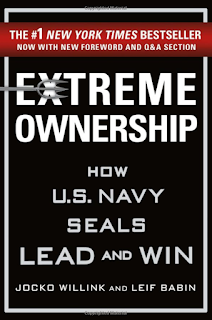
I'm currently reading Extreme Ownership, How U.S. Navy SEALS Lead and Win, by Jocko Willink and Lief Babin. This book was given to me by a banker, by the way. In the book, the authors say this about empowering junior leaders, like branch managers (parentheticals are mine):


"Teams must be broken down into manageable elements of four to five operators (i.e. a branch), with a clearly designated leader (i.e. a branch manager). Those leaders must understand the overall mission, and the ultimate goal of that mission. Junior leaders must be empowered to make decisions on key tasks necessary to accomplish that mission in the most effective and efficient manner possible. Teams within teams (i.e. retail/small business banking-regionals-branches) are organized for maximum effectiveness, with leaders who have clearly delineated responsibilities. Every tactical-level team leader must understand not just what to do but why they are doing it."


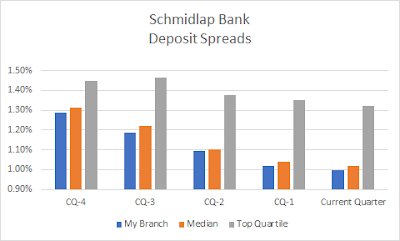
So what of that Schmidlap National Bank plan: Vision-Be the number one business bank in our markets. Strategic Objective-Achieve top quartile cost of funds with an emphasis on growing business deposits.

The head of retail, or the regional manager if a larger bank, can set the strategic goal for the Elm Street Branch (My Branch in the below chart) to achieve top quartile deposit spread in the branch network. 


Deposit spread is a key metric in any worthwhile branch profitability system. Understanding how deposit spread is calculated and how to impact it is easily taught and understood. I wasn't from the Finance function, and I once was a branch manager, and I understand it. In fact, I believe not using branch profitability because we don't think branch managers, regional managers, or even the head of retail/ small business banking will understand it is patronizing. Or quite possibly you've made these reports overly complex. Which is the enemy of effectiveness.

No, I think My Branch's goal of achieving top quartile deposit spread by some future period is specific, measurable, aggressive yet achievable (a quarter of your own branches achieve it), relevant (to the strategic objective), and time based (i.e. a SMART goal). 

After setting the strategic goal, and ensuring the branch manager understands how it is calculated and how to impact it, the regional manager can then empower the branch manager to develop a tactical plan to achieve it. Some may include dependencies, as many of the Chris Nichols' "7 Steps" require Marketing support. This support can be coordinated over the franchise, as in "how will Marketing help our branches achieve their goals?"

But this doesn't mean the branch manager can't highlight tactics to help the branch succeed, such as: 


1. Develop list of businesses within five miles of branch by NAICS code, cross reference with existing branch customers.

2. Focus on the most promising businesses' in industries where our bank can be successful competitively.

3. Perform competitor analysis using Amberoon tool (Step 3 in Chris Nichols article)

4. Leverage bank-developed and curated business-focused content to communicate with businesses identified in (2).

5. Branch manager/assistant branch manager to complete ABA Small Business Banker certification.

6. Implement business calling program as developed/instructed by [Internal training/ external consultant, etc.]


This, of course, is a summary list of strategic initiatives to achieve the goal that emanated from the whole bank's strategic objective to "achieve top quartile cost of funds with an emphasis on growing business deposits."

And if the bank is a learning organization, then each branch is empowered to experiment (within guidelines) to develop what works well, what must be refined, and what doesn't work. If the bank creates appropriate feedback loops, this can exponentially increase the effectiveness of strategic initiatives that are laser-focused on achieving the overall bank strategic objectives and vision. 

It is the very definition of rowing in the same direction. And it creates a culture where branch managers own their role in strategy execution, goal achievement, and the tactics to succeed. 

Have you experienced this level of ownership?


~ Jeff


Notes:

I mentioned that profitability reporting is a core competency of my firm. To learn more, click here. 


And please consider reading my book: Squared Away-How Can Bankers Succeed as Economic First Responders. 

Ten percent of author royalties go to K9sForWarriors.org, who work to bring down the suicide rate among our veterans. 

Kindle

Paperback

Hardcover

Thank you!


Tuesday, November 30, 2021

I'm All Fired Up!

//Note: This is not a banking post.//


 "Ain't nobody livin' in a perfect world,

And everybody's out there, cryin' to be heard

And now I got a new fire, burnin' in my eyes

Lightin' up the darkness, movin' like a meteorite."


I'm All Fired Up!


This past Sunday, CBS Sunday Morning ran an excellent segment on Pat Benatar and husband / lifelong bandmate Neil Girardo. I loved Pat Benatar growing up. And today I still crank the volume when she comes on Classic Rewind on my radio.

And then they dropped a truth bomb on me: Pat Benatar is not in the Rock and Roll Hall of fame. 


WTH!

How does Gene Vincent & His Blue Caps (inducted) feel about that? I bet Sam & Dave (inducted) would also be miffed. 


"Knock me down, it's all in vain,

I'll get right back on my feet again."


Facts

You know I'm about the facts. 

So I consulted Cleveland.com 2019 ranking of all Hall of Fame inductees, using their "Marginal Inductee" list to compare their Gold, Platinum, Multi-Platinum, and Diamond albums to Benatar's. Now, Cleveland.com developed an objective way to create their rankings. Visit the article here. But don't come at me for who is on the list. 

I then cross-referenced to the Recording Industry Association of America's tallies for most Gold, Platinum, Multi-Platinum and Diamond selling albums. The results of Benatar compared to the Marginal Inductee list are below, except most of them did not even make the RIAA list. The one's that did, are listed below. In other words all except Benatar are in the Hall.


Trust the Process

In 2016, the CEO of the Rock and Roll Hall of Fame discussed the nomination process as this...


A Rock and Roll Hall of Fame Nominating Committee, consisting of "roughly 24 people", who remain top secret so artists don't lobby them, gets to nominate two artists for induction. That brings the total to around 50. The committee then has an open discussion behind closed doors (which seems ironic), narrowing the list to 15 nominees. Ballots are then sent to nearly 600 rock and roll historians, members of the music industry, and artists including every living member that has been inducted.


Since 2012, the voting process has also included a fan vote, with the top-five fan vote getters being thrown into the voting process. This year's fan vote yielded Tina Turner as the number one fan vote getter, and she was inducted. 

And yet, this process hasn't produced Pat Benatar.


In the CBS Sunday interview, Pat and Neil were magnanimous about it. They don't need the validation. But I need it for all of the albums, 8-tracks, and cassettes I bought and wore out!


"We belong to the light,

We belong to the thunder."


And Pat belongs in the Hall!


To vote, go to www.rockhall.com. Fan votes for 2021 went through May 7th. So when it opens for 2022, vote Pat Benatar in! 


I'm all fired up. And so should you!


~ Jeff


Sunday, November 07, 2021

Banks Should Avoid Rabbit Holes

We have much work to do, little resources to get it done, and a short time to make it happen. So we should avoid doing things that don't benefit our stakeholders. Even following stakeholder primacy, to the non-believer, thinks it is an unnecessary pursuit that distracts us from delivering to shareholders.

That is what a bank CEO told me recently. My case in my book, Squared Away-How Can Bankers Succeed as Economic First Responders, was that pursuing stakeholder primacy mitigates one of the greatest threats to the community bank-relevance. If you matter to your stakeholders, you are relevant, maybe even important, to your employees, customers, communities, and shareholders. And that the disciplined approach to stakeholder primacy should lead to greater shareholder returns. Minimally, not lower shareholder returns.

But we are under pressure to do many things with our business model. Some urgent, some important, some not so much. I was reminded of this competition for our time and resources by my friends at Cross Financial who tweeted out the Eisenhower Matrix, whose namesake came from our 34th president when he quipped: "I have two kinds of problems, the urgent and the important. The urgent are not important, and the important are never urgent." The below chart was elevated in prominence by the Stephen Covey book The Seven Habits of Highly Effective People. 


But how do you identify the important? When thinking of this problem, it brought me back to Rotary International's Four Way Test for deciding what and what not to do: 1) Is it the truth? 2) Is it fair to all concerned? 3) Will it build goodwill and better friendships? 4) Will it be beneficial to all concerned?


Rabbit Holes

Back to rabbit holes. I propose the Four Way Test of Avoiding Rabbit Holes. A decision tree, if you will.


1. MUST you do it? If you are being compelled by law, regulation, accounting standard, contract, etc. to do something, then you must do it. You might not like doing it, but take that up with your trade association(s). Avoid arguments that you must do something that you, actually, are not compelled to do. Such as we "must" implement so and so because of some "non-compulsory" reason. This is the first decision point, and if you are compelled to do it. Just do it. Hard stop.


2. Is it consistent with strategy? I was recently on a call with a fintech that facilitates international B2B and P2P payments. It was a white label solution that can be woven into the bank's tech stack. It was cool. But is it consistent with the bank's strategy? When my firm discusses the direction of our industry, we make the point that there are fintechs that want to partner with banks for nearly every solution, customer facing or "run the bank" solutions. In most cases, many competing fintechs are available to help you out. But dial up your strategic plan. Is that customer experience solution consistent with the demands of your current or prospective high lifetime value customers? 


3. Will it benefit multiple stakeholders? And ideally, all stakeholders (employees, customers, communities, and shareholders). Today's employee will not feel purpose in their work if your culture is to maximize profit for the benefit of shareholders alone. And that employee will be a short-timer if that's your culture. Leaving you with the button mashers that consider you their nine to five and work solely for a paycheck. Will that employee seek and destroy unnecessary processes, maximize your use of technology, and deliver a superior customer experience? I sat next to a pretty savvy director of a community bank that says he became a customer, and later a director, because the bank commits seven percent of net income to community organizations. It wasn't the bank's technology or its capabilities to serve his business. It was their commitment to community. If you are considering a zero-sum investment, one that benefits one stakeholder at the expense of another, pass on that rabbit hole and instill discipline in those that propose strategic investments to find the win-wins. 


4. Will it protect the bank? Banking is a risk business and risks must be accepted, mitigated, or eliminated. Whatever risk framework you use, be it the Federal Reserve Board or OCC's risk categories, will what is proposed mitigate or eliminate the risks you chose not to accept? This can get murky, as strategic and legal risk are often in a bank's risk framework that the institution would like to mitigate (because eliminate is all but impossible, even for insured risks). So the person proposing you go down a rabbit hole may invoke "strategic risk" to convince you to go with them. For these instances, I propose calculating the likelihood of the risk coming to fruition. If you deem it to be an unlikely strategic risk that will take plenty of resources to mitigate, pass.


Let your competitors go down rabbit holes while you dedicate the resources to execute your strategy and protect your bank.


Here is a picture of the decision tree, as I see it. If you can't download the image and you want it, drop me a request and I'll send to you.


How do you avoid rabbit holes?


~ Jeff


Note: I would like to thank all veterans that stepped forward when asked to step in front of the rifle, drive over the roadside bomb, and sail in mined waters a Happy Veterans' Day.


And please consider reading my book: Squared Away-How Can Bankers Succeed as Economic First Responders. 

Ten percent of author royalties go to K9sForWarriors.org, who work to bring down the suicide rate among our veterans. 

Kindle

Paperback

Hardcover

Thank you!