Sunday, March 27, 2022

Bankers: Just Do It!

"That's all fine and good, but if your bank doesn't do it or the reporting doesn't get to the front line, how can we improve?"

~ Montana Bankers' Association Executive Development Program Student


Sing from the same sheet of music. Row in the same direction. Everyone should be on the same page. 


Do we really want this? 


I'm finishing my annual tour of the West teaching bank profitability as part of various states' Executive Development Programs. Students are typically mid-level and have high potential. As part of that class, we drill down from "top-of-the-house" financial metrics, such as ROA, Net Interest Margin, Efficiency Ratio, to the most granular numbers, such as the ROE hurdle rate of a customer relationship.

Few have access to information at the line of business, product, or relationship level. Branch managers were unaware of their P&L, lenders were unaware of the ROE of their portfolio. And for me... disappointment.

Because if we want everyone from the Board Room to the customer contact person to "sing from the same sheet of music", why on earth do we have executive incentives tied to Return on Equity but hold lenders accountable for loan volume? It is inconsistent. In fact, it incents lenders to work against your ROE, promoting larger, thinly priced deals without regard for structure, duration, or capital needed to support the loan. It is the antithesis of "rowing in the same direction."

Imagine, holding lenders accountable for the continuous pre-tax profit and ROE improvement of their loan book, like the table below.


We either: don't do this (most likely), or do this but allow naysayers to poke holes into the art part of management reporting because they don't look particularly good (lack of leadership), or do this and keep it bottled up in the executive suite (nice to know). I realize my firm has self-interest in the first reason because we do this on an outsourced basis for financial institutions. But that aside, everyone should do this! Imagine the behavioral changes this would foster. Behaviors we now try to control with incentive schemes to offset the unintended negative consequences of incenting on volume. 

I recently wrote about Branch Profitability in Practice, so I won't belabor the point on holding branches accountable for continuous profit improvement.  A bank CEO recently asked me if I thought using branch pre-tax profit rankings amongst all of his bank's branches would be an incentive that is consistent with the bank's strategy. Knowing the CEO's passion about being a superior financial performer, of course it would! His top quartile branches in pre-tax profit should receive a greater bonus pool than his bottom quartile. Again, this bank has the luxury to do this, because they measure profitability of their branches. Those that don't use deposit growth, or net new accounts, or some other metric that's easy to get out of their core but may not be consistent with strategy.

Don't leave support centers in the lurch. If you incent your Compliance Department with no audit exceptions, should it be a surprise that it was next to impossible to get online account opening off of the ground when branchless banks have been doing it for a decade? How about incenting them on how quickly audit exceptions are cured? Think of the cultural change.

There are ways to incent other support centers to row in the same direction as strategy. If the executive team is incented on being efficient compared to peer, wouldn't it be consistent to incent the Loan Servicing Department on their operating expense to average loans? That combined with loans serviced per Loan Servicing FTE would make for a transparent incentive that has that Department singing from the same sheet of music as the overall bank.

I think I've thrown enough management bromides at you.

We continue to talk about implementing the solutions to serve our most valuable customers without having any idea who the most valuable customers are. Imagine if the lender had 50 relationships, 10 over his/her ROE hurdle rate (white glove service), 20 hovering at or under the hurdle rate (take action to get them over it), and 20 are far under the hurdle rate (efficiently serve them). But we don't do it.

Imagine if the branch gave the best service to those customers most valuable to that branch. If only they knew who they were. Maybe we should.

Instead of accepting how we currently do it, perhaps we should do it like it should be done. In a changing financial world full of shiny objects and the need for focus, we should know the profit trend of the residential lending department, our commercial lenders, our branches, and our most valuable customers. How else would we know they are the most profitable?

Stop accepting incentives not consistent with strategy. Don't leave profitability behind in your data journey. 

Just Do It!  


~ Jeff


Saturday, March 05, 2022

Guest Post: Financial Markets and Economic Update by Dorothy Jaworski

Winter Squalls

It’s mid-February and I’m watching a snow squall outside, reminding me that it can be bright and sunny one moment and turbulent the next.  As we try to navigate our way through this volatile time in the markets and in the economy, we seem to get surprised almost daily by large moves in the stock markets, already in correction territory, in the bond markets with rapid interest rate increases, in the highest inflation in 40 years, and in the tense situation surrounding Russia and Ukraine.  And I don’t mean to sound downbeat, but the Federal Reserve is about to raise interest rates amid an economy that is already showing cracks.

The economy seems to be slowing, despite glowing reports like the +6.9% growth in real GDP in the fourth quarter, strong payroll growth in January with the unemployment rate at 4%, and inventory building that could be the first step in solving supply chain issues.  In fact, inventories accounted for +5.0% of the +6.9% GDP growth, leaving only +1.9% in real final sales, which is very weak compared to +8% to +9% in the first two quarters of 2021.  Many businesses are seeing labor shortages, as we are still several million payrolls short of where we were in early 2020.  Inflation may be a large culprit in slowing growth as people cut back on discretionary items to be able to afford the necessities of life - food, gas, electricity, etc.

Stock and bond market volatilities are also seeing winter squalls and are sending messages about shifting investor sentiments about risk.  The Fed is about to embark on another tightening campaign and will raise short-term interest rates starting in March and will likely make moves faster than most investors expect.  They will have ended their bond purchase program and will shift in a few months to letting their massive assets (currently close to $9 trillion) begin to run off.  Investors have seen this movie before and are fearful of recession in 2023 or 2024.  Credit spreads have begun to widen.  At the same time as Fed tightening, the fiscal policy of handing out “free money” has apparently ended and the consequential explosion of demand will abate.  They have to stop; our Treasury debt is massive at over $30 trillion.  People know the “free money” and easy Fed policy were certainly not “free” and they are paying the price with inflation.

Interest rates have risen dramatically since the beginning of 2022, with the 2 year Treasury up .76% and the 10 year Treasury up .42%.  With inflation so high, we have negative real yields, which means over time good returns on investment are difficult to attain, so we may see cuts in business investment.  Interest rates also seem distorted compared to equity returns, with the 10 year Treasury at 1.92% and the S&P 500 forward dividend yield at 1.57%.  Shouldn’t these be the other way around?  As rates have risen, the yield curve has flattened, with long-term points of it inverted (20 year and 30 year).  Flat and inverted yield curves are not a good sign before the Fed even raises rates once.

As mentioned earlier, consumer spending likely will slow as excess demand fades.  The old misery index, defined as unemployment plus CPI inflation, tells the story of everyday living.  The index is currently at 11.5% in January (4% plus 7.5%), which is the highest since 10.4% in May, 2012, but not near the all-time high of 22.0% in June, 1980.  Oil is above $90 per barrel and gas prices are above $3.80 per gallon.  Consumers may reach a “tipping point” where they cut spending dramatically because of their anger at energy prices getting too high.

Finally, the index of leading economic indicators fell by -.3% in January, which was the first monthly decline since the beginning of 2021.  It portends slowing growth six to nine months from now.  Fed policy also works with a lag of six to nine months.  The end of 2022 could be very interesting from all angles, including the federal mid-term elections, and may still be full of winter squalls.


Real GDP

We just experienced one of our strongest GDP growth quarters, with real GDP at +6.9% in the fourth quarter of 2021.  Inventory building accounted for the vast majority of that growth, or +5.0%.  Real final sales grew only +1.9%, which is weak, and followed only +.1% in the third quarter.  GDP for all of 2021 was +5.7%, following a year of decline in 2020 of -3.4% due to Covid-19 lockdowns.

Too much stimulus from the federal government drove demand too high in 2021.  Nominal GDP was +10.6% in the first quarter and grew to +13.9% in the fourth quarter as consumers shifted to buying goods rather than services, and supplies could not keep up.  We’ve heard all about the supply chain issues - from manufacturing to distribution- from cargo ships to trucking.  The federal stimulus also drove our national debt levels to over $30 trillion, or 123.4% of GDP.  As we learned during the expansionary decade of 2010 to 2020, GDP greater than 90% for several years will lower GDP by one-third.  Growth only averaged +2.2% during that time, albeit with the bonus of low inflation.

Consumer spending, which represents about two-thirds of the economy, is already weakening as excess demand fades.  Consumer confidence is at relatively low levels, mostly attributed to the inflation shock.  Prospects for growth this year are decent at +3.8% GDP and most estimates project lower growth of +2.5% in 2023, which is back to the lower equilibrium growth rate of just over 2%.  Can the Fed carefully engineer the slowing of growth without risking recession?  We shall see how aggressive their tightening campaign is.


Inflation

Oh, the monster!  Oh, the misery!  We all hate inflation.  The prices of just about everything that matters to us are rising- food, energy, medical care, housing and rent, new and used cars, electricity, clothing…the list can go on.  The CPI started 2021 at +1.4% to +1.7%, rose to +5.4% by mid-year, and ended December at +7.3%.  January rose again to +7.5%.  Inflation has eroded spending power with real incomes dropping -4% by the end of 2021, even though wages were rising +4.5% year-over-year.  The Fed started out saying inflation was “transitory” but had to admit later it was “persistent.”  Now we will see if the Fed can keep it from becoming “sustained,” with wage inflation from tight labor markets filtering into the prices of all goods and services. 

Inventories of existing homes has been extremely tight, at 1.6 months’ worth of sales in January, driving recent year-over-year prices on homes up +17.5% to +18.5%.  Higher mortgage rates will undoubtedly reduce demand, with 30 year mortgage rates now above 4% reducing affordability.  CoreLogic expects price increases to decline to +3% to +10% during 2022.

We scream at how bad inflation is when it is at its worst.  There are some clues that inflation may stop rising or recede soon, as supply chains get repaired and more goods flow.  We saw inventory building of a huge scale in the fourth quarter, so a surplus of goods, at a time when demand is declining, is not a prescription for higher prices.  Backlogs are declining in a sign that goods orders are being met.  The flood of government stimulus has faded and the declining budget deficit to GDP, from 5% in 2020 to less than 1% now, points to lower inflation in the year ahead.

Productivity has been on the rise, with capital investment in technology and machines, and may serve to keep unit labor costs in check and profit margins stable.  The dollar has been strong, keeping import prices lower than they otherwise would have been.

Inflationary expectations built into the Treasury market show inflation declining over time:  2 years at 3.55%, 5 years at 2.93%, and 10 years at 2.50%.  if the markets thought inflation would be 7% or higher, yields would already be there.  Even Larry Summers, one of our nation’s biggest inflation hawks, thinks CPI will fall back some to 4% this year.


Supply Chains and Labor Shortages

They are connected.  The huge increase in demand exposed the flaws in our systems.  Delivery issues, especially from ocean freight and port back-ups, left many manufacturers short of goods to run production lines and store shelves were left bare.  Labor shortages also played a key role.  Spikes in new Covid-19 variants led to record high employee absences.  But workers are still leaving the labor force from the Great Resignation, retirements, child care issues or costs, burnout and work-life balance, or starting their own small businesses. 

The unemployment rate is down to 4%, but we are only at 87% of pre-pandemic worker levels and are missing 2.9 million people.  The pool of available workers is at 12.217 million in January, which is 2 million higher than in early 2020.  Yet, mysteriously, we are still short workers. 


The Fed

We are entering another cycle of Fed tightening.  They will be raising the Fed Funds rate starting in March and are likely to raise it a total of four to five times (.25% each) by the end of 2022.  They met their objective of getting unemployment back to full employment, estimated at 3.5% to 4.3%, and now they must tighten against the highest inflation in 40 years of +7.5% and the tightest labor market in terms of wages increases in a decade, at +5.7% in January.

Market interest rates have risen in anticipation of Fed tightening.  In just six weeks, the 2 year Treasury is up .76%, the 5 year is up .40% and the 10 year is up .42%.  Both 15 and 30 year mortgage rates are up even more at +.80%.  The Fed is very happy to have the markets do some of their job for them.   Remember that Fed policy operates with a lag.  By the end of 2022, we should see the economy slowing and hopefully inflation receding.

Finally, all of you Phillips Curvers are rejoicing right now.  After 10 years of warning us that low unemployment leads to high inflation, you have finally gotten your moment of Schadenfreude!  Enjoy and thanks for reading!


DJ  02/19/22


Dorothy Jaworski has worked at large and small banks for over 30 years; much of that time has been spent in investment portfolio management, risk management, and financial analysis. Dorothy has been with Penn Community Bank and its predecessor since November, 2004. She is the author of Just Another Good Soldier, and Honoring Stephen Jaworski, which details the 11th Infantry Regiment's WWII crossing of the Moselle River where her uncle, Pfc. Stephen W. Jaworski, gave his last full measure of devotion.

She also was our guest on my firm's January 2022 podcast, This Month in Banking. To listen to that episode on interest rates and the economy, click here or go to wherever you get your podcasts.

Thursday, February 24, 2022

Things I Wish Bankers Did Better: Project Management

PPP urgency must be our norm.

On September 17, 2021 in the Scottsdale, Arizona desert, I delivered a speech to a ballroom full of bankers titled: 5 Things I Wish We Did Better. It was well received and was recently picked up by a banking school as an elective class.

Number 1 on that list: Project Management. I used the embedded commercial as indicative of the life span of a project at a community bank. In my presentation, I estimated the following: Time to identify high lifetime value customer segments to uncover their demands, 4 months; Actually uncovering their demands and solutions providers, 4 months; Select the solution, 4 months; Implement the solution, 6 months. That's a year and a half for those counting.


And my observation was validated at a recent bank strategic planning retreat where the strategy team said solutions contracts that they signed last year will be lucky to be implemented by the end of this year. Their experience is consistent with my observation.

This, in my opinion, is an existential threat to the relevance and survival of community banking. We have to be able to identify, implement, utilize and market technology solutions using PPP-level speed and urgency.


Can it be done? At Bank Director's Acquire or Be Acquired conference, Anthony Morris from nCino, in a Transformation Through Technology panel, gave a sample timeline of project implementation (time to implement) of four months, followed by a time to value (time from implementation until the solution adds value) of an additional two to three months.

I thought he was being wildly optimistic.

But Jill Castilla of Citizens Bank of Edmond told me that it took her community bank 10 days from idea to implementation for PPP.Bank, which was a critical tool in the early, wild-west days of the first wave of PPP loans. Ten days. Her bank at the time was just over $300 million in total assets and she had 56 FTEs. 

Mike Butler, CEO of Grasshopper Bank, thinks rapid tech integration shouldn't be anomalous. Mike has a history of getting solutions quickly from idea, to implementation, to time-to-value in his prior life as CEO of Radius Bank (acquired by LendingClub) and now at Grasshopper. They changed their core in four months! They contracted with a vendor for online account opening in November and are flipping the "on" switch this month. What's their secret sauce, according to Mike?

- Hire a rock star CTO, which he doesn't believe is the norm in community banking. He didn't define what he meant, but in my mind I think a rock star CTO does not allow hurdles, either erected by solutions providers or internal naysayers, to slow down the bank from its current state to its desired one. A rock star CTO is a plow driver, not a caution cone erector.

- Have a killer project management team inside the bank.

- Use the API concept to circumvent the fortress that cores build around their solution. This likely requires you to have the traditional core middleware that they will charge you for, but it avoids getting on the "we'll get back to you based on your size and how busy we are" attitude that community banks suffer as a result of core dependency.

- Don't try to boil the ocean. Use the MVP concept (minimum viable product) and GO! Solve one specific problem at a time rather than trying to solve multiple or all problems. Don't wait until perfection to launch. Launch and learn, make course corrections.


Linda Stahl, Chief Revenue Officer of Paladinfs, herself a recovering core provider veteran, thinks core dependency is getting worse, citing that it used to take 80 days on average to negotiate a core contract. And it's now taking 180 days on average. Once under contract, the time to convert is about nine months. The future, in her estimation, is that the core will serve as the record keeping solution, and we will use API based plug and play based on a bank's needs. But we're not there yet. We still require the core middleware as a bridge to the future, which an estimated half of all banks do, and cores charge tolls for access to your data. 

To navigate from now until a future, API-based plug and play state, Linda suggests building into your technology contracts specific service level agreements (SLAs) that have progressively sharper teeth. SLAs should essentially be a statement of work with milestones. If the technology solution doesn't meet the first or second milestone, there is a financial penalty such as credits or an outright cash payment. If it escalates to missing the third or fourth SLA, the bank can terminate the contract without penalty. Mike Butler suggests discipline in enforcing technology solution SLAs. Have some gumption. Although he used a more colorful word than gumption.


This week I noticed that my large financial institution had been charging me $15 per month for an account I used to pay my 23yo's college bills because I must have blown through their minimum balance as her college days neared the end. A tech-forward, trust-based financial institution that spends billions per year on technology should have sent notice to me or some relationship manager that this was happening. But no, I found out by accident a year after it started. If we think because our largest competitors that frequently brag about their tech spend are squared away, think again. 

A key strength a community bank has over those large institutions that dominate market share is we can act quickly. The context of the strength is in decision making or making strategic pivots. This strength should not exclude tech implementation. And it is in tech project management where we need to significantly improve.


~ Jeff


Please consider reading my book: Squared Away-How Can Bankers Succeed as Economic First Responders

Ten percent of author royalties go to K9sForWarriors.org, who work to bring down the suicide rate among our veterans. 

Kindle

Paperback

Hardcover

Thank you!


Saturday, January 15, 2022

Four Leadership Lessons Learned from St. Paul's Crusaders

Leadership is taking limited information and striking down a path with the commitment needed to succeed in the endeavor. It is motivating others to follow you into uncertainty, while maximizing their ability to contribute to success. It is filling each teammates emotional tank so they self-motivate to maximize their strengths and contribute to the team. 

I moderated a strategic planning retreat where bankers were debating employee development. A senior manager quipped about "coaching." The CEO asked, "do we really coach?" "I'm reading a book by Bill Cowher (former Pittsburgh Steelers head coach), and we don't do what Cowher has done."

Coaching sports is a highly accountable form of leadership. Are you maximizing the talents of individual team members? Are you improving how they work together to create a high functioning team? In sports, the results are on the board. Wins and losses. Statistics for nearly every function. In my book, Squared Away: How Can Bankers Succeed as Economic First Responders, I told how the Positive Coaching Alliance helped me become a better girls lacrosse coach, and as a result, a better leader.

The banker's comments on Coach Cowher got me thinking about coaches in my life and what they taught me about leadership. Two such underappreciated coaches were Coach McLaughlin and Coach Hewitt from my middle school basketball team: St. Paul's Crusaders in Scranton, Pennsylvania.


St. Paul's

First, a little background. Most people that grew up in Scranton when I did were Catholic. And the middle school Catholic basketball league was highly competitive. St. Paul's usually fielded an excellent team, as was the case in 1979-80. 


I was an average player at best. A couple notches down the bench from our best. But I had some skill and probably more potential. But my attitude got in the way. I could have been a better player. But I thought the effort wasn't worth it because I was, shall I say, in a different economic situation than most of my teammates. My father passed away when I was young. Most of my teammates had both parents, and were more affluent than me and my family. I was fortunate to receive discounted tuition so I could attend the school. My mother told me that my father, prior to his death, asked her to keep us in Catholic school as long as she was able. 

This situation resulted in a chip on my shoulder that impacted my attitude, and therefore my effort. Why put forth what it will take to hone my skills only to see the privileged kids get the playing time anyway? This attitude manifested itself when a player brought up from the 7th grade team started getting more playing time than me. I promptly quit.

I was deep in the victim rabbit hole.

But my coaches wouldn't let me go. Although, looking back at it with open eyes, they should have. My bad attitude was impacting other players. My biggest regret from 8th grade basketball was not my attitude and effort, and the ease that I painted myself a victim (although both were lamentable); it was that I influenced others to share my victimhood. 


Lessons Learned

What did I learn from Coaches McLaughlin and Hewitt that are instructive for us as leaders?


1.  Think Big Picture. I was what is currently termed an "at-risk" kid. I was in a single parent household where the parent worked and my choices would have a big impact on the direction of my life. I didn't know this. I was 14! But my coaches did. If they allowed me to quit, how would I spend that newfound time? And how could they influence the direction I took? In other words, how could they coach me? If you are challenged by team members with a bad attitude that impacts their effort and performance, think about how you can positively impact that person's trajectory and be a transformational person in their lives. I'm not suggesting tolerating or ignoring the attitude issue, but tackle it in such a manner that makes them better and a team contributor. 


2.  Reward great attitude and effort consistently. As my attitude worsened, and my effort slipped, it opened the door for another player, likely without as much talent and potential as me (although it is difficult to self-evaluate), to get more playing time. This is exactly what happened at St. Paul's. My sulking on the bench led to another player's opportunity. He had a great attitude and worked really hard in practice. In fact, his hard work actually served as part of my rehabilitation. How can I slack while this kid is working it? The coaches rewarded him with more playing time for his attitude and effort. Even at 14, I realized it. And he deserved it. That kid went on to be a positive contributor to his high school basketball team.


3.  Learn the "Why". What if my coaches viewed me without context? Me quitting should have been accompanied by them muttering "good riddance." In my dark days of victimhood I was a detriment to the team. I was negatively impacting other players, my teammates, my friends! It would have been a very bad day for the direction of my life if my coaches had no context to my situation and what was driving my attitude. They took some lumps from me. They were stern when they needed to be. More so with me because of where I was, my behavior, and my situation. Short term I might have thought their treatment of me was relating to my economic and family situation. In retrospect, they understood my situation and tried to be the coach that I needed at that time. Each person needs something different from their leaders. It is the leaders' job to find out the "why" and approach the relationship from that context.


4.  Communicate! In a 2013 article, Lead Like Lincoln, I highlighted communication as one of our former president's greatest leadership traits. During the Civil War, I doubt any of the top generals asked themselves "I wonder where Lincoln would stand on this?" He used to communicate directly with his generals so there was no doubt where he stood on the big issues. Communication is a two way street. As the saying goes, you have one mouth, two ears. Active listening is important. When communicating with a 14 year old, my coaches not only had to listen to what I was saying, but the nuances as to what I was meaning. I certainly wouldn't come straight out and say "Why bother trying? The privileged kid has my position locked down." Classic don't try-can't fail. Even to someone my age, that would sound petty. So my coaches communicated what they were doing, and my role in it. This probably brought me back from the brink on that day that I handed in my uniform. I realized what they wanted and my role in it. They understood my attitude, and eventually I learned the basis for my attitude was wrong.


I got over it. Although it took time, and was a process not an event. By the time I crawled out of the victim rabbit hole I was no longer in middle school. So perhaps my coaches never knew the impact they had on me. But it was profound. And I have been a crusader against painting myself a victim ever since. And I credit the transformational leaders that helped me on the journey.


Thank you Coach McLaughlin and Coach Hewitt!


~ Jeff


Friday, January 07, 2022

Jeff For Banks: Top Five Posts of 2021

I don't expect followers of my blog to read every post. And my blog page shows the top five posts of all time. In fact, the content in my book, Squared Away: How Can Bankers Succeed as Economic First Responders, was driven by the top 20 most-read posts of all time.

But what about recently? Here are the top five most-read posts of 2021. In case you want to read them.


1. The Death of the Community Bank

Pundits make predictions. And I jumped in with both feet with a presentation I made in 2008. When I dug it out of my archives, I reviewed those past predictions with what actually happened. Where was I right? Where was I wrong?


2. CFPB: Are They Coming To Get You?

Written in March in response to questions a bank trade association CEO asked me as he was penning an Op-Ed, I did not know how prescient this piece would be. The questions were relating to the CFPB director contemplating taking "aggressive action" against those that were perceived to engage in Covid relief violations. Well that turned out to be the first piece of popcorn on the trail of a far more aggressive CFPB that is likely to get the majority of good banks sucked into the vortex with the few bad ones.


3. Squared Away: How It Happened

Since I had never published a book, I had no idea how to approach writing a book. Perhaps many of my readers are contemplating putting pen to paper and sharing what they've learned with a larger audience. And this drew them to how it came about for me. Hint: It wasn't all sunshine and rainbows. It took discipline. Except for the title. That was a family fun brainstorming session.


4. Memorial Day: Remember Maurice "Maury" Hukill

One thing I have learned about community bankers is they truly appreciate the sacrifices others made that allowed them to pursue a career in community banking. I highlight a fallen service member every Memorial Day. And this one had the most views of all of them. Perhaps it was boosted because Maury was a native of my hometown, and I pushed this out to my Facebook friends too. So there were probably a bunch of views that were not bankers. But still, I salute you, my readers, for elevating this tribute.


5. Bankers: Seven Questions to Determine if You Have a Strategic CFO

The consulting firm Deloitte posited seven questions to determine if the reader was (if he/she was a CFO) or has a strategic CFO. I posted the questions, provided the Deloitte meaning, and then connected it to banking. I hope you or your CFO fit the bill.


My Pick

Probably because it was such an important and high-level issue, Banking's Execution Imperative was my favorite. Although it did not take home Top 5 hardware. I rarely see bankers determine their strategy willy-nilly. Instead they put in the effort. Get executives and the Board involved. Dig through data to come up with the best strategy for their bank, in their current situation. And a year later when we follow up on progress, we hear about their "day job." If you're an executive, strategy development and execution is your day job. 


Honorable Mention

Although this post was published in November 2020, it still had enough legs to be one of the top read of 2021. Dorothy has been a mainstay of our blog. She had been writing her commentary for some years for physical distribution to her bank's customers. Finally, the Marketing Department was on to her and began posting directly to the bank's website. She'll be missed on these pages. But you can catch her on our next This Month in Banking podcast waxing eloquent on what bankers should do in this uncertain interest rate environment. That release date is January 26th. Get it here or wherever you get your podcasts.


Thank you to all of my readers. I don't take you for granted and will continue to be thoughtful in how I, and my colleagues at The Kafafian Group, can bring value to you and your teams. WE WANT YOU, YOUR EMPLOYEES, CUSTOMERS, COMMUNITIES AND SHARHOLDERS TO WIN!


~ Jeff


Wednesday, December 29, 2021

Banking's Top 5 Total Return to Shareholders: 2021 Edition


For the past decade I searched for the Top 5 financial institutions in five-year total return to shareholders because I support long-term strategic decision making that may not benefit next quarter's or even next year's earnings. And I am weary of the persistent "get big or get out" mentality of many industry pundits. If their platitudes about scale are correct, then the largest FIs should logically demonstrate better shareholder returns, right?

Not so over the ten years I have been keeping track. The first bank to crack the Top 5 over $50 billion did so last year. As a reference, the best SIFI bank in five year total return was Bank of America at 26th overall. 

My method was to search for the best banks based on total return to shareholders over the past five years. I chose five years because banks that focus on year over year returns tend to cut strategic investments come budget time, which hurts their market position, earnings power, and future relevance than those that make those investments. Short-term focus is a common trait of banks that focus on shareholder primacy over stakeholder primacy.

Total return includes two components: capital appreciation and dividends. However, to exclude trading inefficiencies associated with illiquidity, I filtered out those FIs that trade less than 2,000 shares per day. This, naturally, eliminated many of the smaller, illiquid FIs. I also filtered for anomalies such as recent merger announcements as a seller, turnaround situations (losses suffered from 2016 forward), mutual-to-stock conversions, stock dividends/splits without price adjustments, and penny stocks. 

As a point of reference, the S&P US BMI Bank Total Return Index for the five years ended December 27, 2021 was 60.4%.

Before we begin and for comparison purposes, here are last year's top five, as measured in December 2020:

#1.  Silvergate Capital Corporation (NYSE: SI)
#2.  Live Oak Bancshares, Inc. (Nasdaq: LOB)
#3.  Fidelity D&D Bancorp, Inc. (Nasdaq: FDBC)
#4.  Silicon Valley Financial Group (Nasdaq: SIVB)
#5.  Bank First Corporation (Nasdaq: BFC)


Here is this year's list:


Here we are again. The first crypto currency bank to crack the Top 5 has landed the top position two years running, delivering a 1,257% 5-year total return. You read that right. Silvergate had $150 million in total revenue over the past twelve months, and has a market capitalization of $4.7 billion, or 31.4x revenues. It's five-year compound annual growth rate ("CAGR") in earnings per share was a very strong 27.2% (actually 5.75 years starting full-year 2016 ending LTM 9/30/21). It's Price/LTM EPS is 57x. Investors must be expecting much faster earnings growth to earn the valuation this bank currently enjoys. Average digital currency customer deposits were $11.2 billion at September 30, 2021. 
Silvergate also facilitates payments between crypto exchanges via its Silvergate Exchange Network, or SEN. It's current performance for the LTM ended September 30, 2021 was a 0.78% ROA and 10.04% ROE, which doesn't merit the valuation, so growth and greater profitability must be what investors see. Here is Silvergate CEO Alan Lane after third quarter earnings announcement on CNBC. Give Silvergate credit, they picked a niche and are executing on it to the delight of investors. Crypto is blazing hot!


#2. MetroCity Bankshares, Inc. (Nasdaq: MCBS)


MetroCity Bankshares, Inc., and it's banking subsidiary Metro City Bank are headquartered in Atlanta. The bank was founded in 2006 and operates 19 full-service branch locations in multi-ethnic communities in Alabama, Florida, Georgia, New York, New Jersey, Texas and Virginia. Quite the geographic expanse, but not uncommon for ethnic banks. What is unique is, after reviewing the management team and board, there are people of Korean, Malaysian, Indian, and Chinese descent in leadership positions. At least that is what I can tell from the bios. The bank has grown over $1 billion in assets over the last twelve months, from $1.7 billion at September 30, 2020 to $2.8 billion at September 30, 2021. This was fueled mainly with loan growth. No acquisitions during this period. MCBS, with a market cap of $705 million, and LTM revenues (net interest income plus fee income) of $125.5 million, trades at 5.6x revenues. And it had an eye popping LTM ROA of 2.49% and ROE of 21.3%. We see these numbers from heavy SBA or, more recently, heavy residential mortgage producers. And for sure, MCBS is both, but it looks like they have been booking their residential mortgages, showing no YTD gain on sale from their residential mortgage loan production. Given that residential mortgages make up 73% of their loan portfolio, and their yield on loans was 5.16%, it makes me think they do a significant volume of non-conforming loans. But still, they have delivered a five-year total return of 439%! Well done!


#3. Triumph Bancorp, Inc. (Nasdaq: TBK)


Triumph Bancorp, and it's subsidiary TBK Bank, SSB were founded in Dallas, Texas in 1981 and provides commercial and consumer banking products focused on meeting client needs in Texas, Colorado, Kansas, New Mexico, Iowa and Illinois. Triumph also serves a national client base with carrier payment solutions through TriumphPay, invoice factoring through Advance Business Capital LLC d/b/a Triumph Business Capital, insurance through Triumph Insurance Group, Inc. and equipment lending and asset based lending through Triumph Commercial Finance. Phew! Needless to say, they have diverse revenue streams and geographies, which produced a LTM net interest margin of 6.35%, driving an ROA/ROE of 1.98% / 15.42%. Profit numbers were aided by an allowance recapture. You would think such a margin would come with higher non-performing assets to total assets but no, as NPAs/Assets were 30 basis points at September 30th. The bank has nearly doubled in size in the past five years, aided by three whole-bank and one multi-branch acquisition. But during that span they delivered a 375% total return to shareholders. Wow!


#4. Live Oak Bancshares, Inc. (Nasdaq: LOB)

After being conspicuously absent from prior JFB Top Fives, LOB makes it's second showing in a row.  It has been an industry darling due to its dedication to technology experimentation. It was the brain child for the nCino platform, which it formed in 2012 and spun off in 2014. Live Oak was founded in 2007 to provide business loans, primarily Small Business Administration (SBA) guaranteed loans, to select industries, like dentists and veterinarians. Live Oak is now the largest SBA 7(a) lender in the United States. They opened in 2007! But it goes beyond traditional banking. Subsidiaries, in addition to the bank, include: Live Oak Private Wealth, LLC, a registered investment advisor; Canapi Advisors, LLC that provides investment advisory services to new funds focused on providing venture capital to new and emerging fintechs; Live Oak Ventures, Inc. that invests in businesses that align with the company's focus on fintech; Government Loan Solutions, Inc., a management and technology consulting firm that engages in the settlement accounting, and securitization process for SBA and USDA guaranteed loans; and, get this, Live Oak Grove, LLC, which is their on-site restaurant for employees in Wilmington, North Carolina. It's five year total return: 371%! Well done!


#5. SVB Financial Group (Nasdaq: SIVB)


SVB Financial Group, formerly Silicon Valley Financial Group is the parent company of Silicon Valley Bank, long considered a go-to bank for startups. At $191 billion in total assets, SVB remains the largest financial institution to ever break into the Top 5 Total Return to Shareholders. It's going to be difficult to describe what they do in summary. But here I go. They are a diversified financial services company that operates through four segments: Global Commercial Bank, which provides traditional banking services plus some not so traditional like mezzanine lending, acquisition, finance, and corporate working capital facilities, foreign exchange, export/import and standby letters of credit, vineyard development loans, and on and on I could go. SVB Private Bank segment offers traditional private banking and wealth services. The SVB Capital segment provides venture capital investment services that manage funds on behalf of third party limited partner investors. SVB Leerink segment engages in capital markets activities, M&A, and investment banking services. SVB operates through 30 offices in the USA, Canada, UK, Israel, Germany, Denmark, India, Hong Kong, and China. It was founded in 1983. It's largest acquisition in the last five years was Boston Private Holdings, but it has been active in its other segments, including the acquisition of Leerink. It has a LTM ROA of 1.50%, and an ROE of 19.91%. Even at it's relatively large size and battling the law of large numbers, SVB remains known for it's niche in the venture capital and founders space. It's not easy to fight "general bank", but they seem to be doing it. And delivered a 296% five-year total return!  Nice!


There you have it! The JFB Top 5 all stars. As in all prior years, no SIFI banks on the list. Increasingly on the list, though, are niche financial institutions that are making strategic bets that are being rewarded by their shareholders in the form of higher valuations. In fact, all on the list are niche financial institutions. #Instructive

Congratulations to all of the above that developed a specific strategy and is clearly executing well. Your shareholders have been rewarded!


~ Jeff


Note: I make no investment recommendations in my blog. Please do not claim to invest in any security based on what you read here. You should make your own decisions in that regard. FINRA makes people take a test to ensure they know what they are doing before recommending securities. I'm sure that strategy works well.


And please consider reading my book: Squared Away-How Can Bankers Succeed as Economic First Responders

Ten percent of author royalties go to K9sForWarriors.org, who work to bring down the suicide rate among our veterans. 

Kindle

Paperback

Hardcover

Thank you!


Wednesday, December 15, 2021

Row in the Same Direction: Branch Profitability in Practice

Chris Nichols from Southstate Bank Correspondent Bank Division recently wrote an excellent piece about branch profitability, a subject near and dear to my heart because it is one of our core competencies at my firm, The Kafafian Group, Inc.

In that piece, titled Branch Profitability in 7 Steps Using Data, Step 1 was start with Potential Branch Profitability. In that step, Chris made the case for calculating relative profitability to the competition using hypotheticals. And I thought, what if we didn't use hypotheticals? We used our actual profitability metrics, synced them up with our strategic plan, and calculated our journey from current profitability to desired profitability?

This is a tall order because in my experience, branch profitability is not widely calculated, and certainly not widely used in creating the operating discipline needed to deliver to the bank's stakeholders. Instead, it is more common to use easily available metrics that we can draw from our general ledger, core processor, or other systems. We measure aggregate deposit growth, period over period expenses, and number of accounts opened.

But what if this motivates behavior that is not consistent with strategy? For example, growing aggregate deposits might be aligned with overall asset growth objectives, but at what cost? It's a sure way to have the un-empowered branch manager calling the regional manager for rate exceptions to win new money or keep money at the bank. 

I rarely hear bankers state as a strategic objective to grow assets, loans, or deposits at any cost. But that is certainly what you are motivating branch managers to do if you use deposit growth as one of their strategic goals.

Instead, what if the bank aspires to be the number one business bank in their markets? And a strategic objective is to achieve top quartile cost of funds with an emphasis on growing business deposits?

How does that translate to the branch manager? What's their plan? 

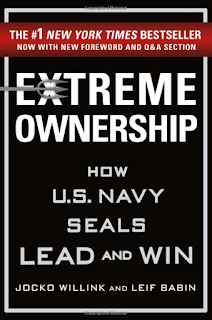
I'm currently reading Extreme Ownership, How U.S. Navy SEALS Lead and Win, by Jocko Willink and Lief Babin. This book was given to me by a banker, by the way. In the book, the authors say this about empowering junior leaders, like branch managers (parentheticals are mine):


"Teams must be broken down into manageable elements of four to five operators (i.e. a branch), with a clearly designated leader (i.e. a branch manager). Those leaders must understand the overall mission, and the ultimate goal of that mission. Junior leaders must be empowered to make decisions on key tasks necessary to accomplish that mission in the most effective and efficient manner possible. Teams within teams (i.e. retail/small business banking-regionals-branches) are organized for maximum effectiveness, with leaders who have clearly delineated responsibilities. Every tactical-level team leader must understand not just what to do but why they are doing it."


So what of that Schmidlap National Bank plan: Vision-Be the number one business bank in our markets. Strategic Objective-Achieve top quartile cost of funds with an emphasis on growing business deposits.

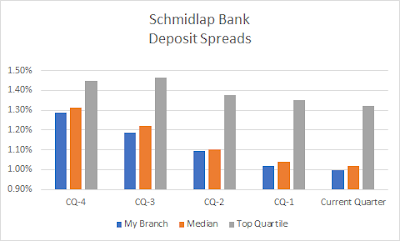
The head of retail, or the regional manager if a larger bank, can set the strategic goal for the Elm Street Branch (My Branch in the below chart) to achieve top quartile deposit spread in the branch network. 


Deposit spread is a key metric in any worthwhile branch profitability system. Understanding how deposit spread is calculated and how to impact it is easily taught and understood. I wasn't from the Finance function, and I once was a branch manager, and I understand it. In fact, I believe not using branch profitability because we don't think branch managers, regional managers, or even the head of retail/ small business banking will understand it is patronizing. Or quite possibly you've made these reports overly complex. Which is the enemy of effectiveness.

No, I think My Branch's goal of achieving top quartile deposit spread by some future period is specific, measurable, aggressive yet achievable (a quarter of your own branches achieve it), relevant (to the strategic objective), and time based (i.e. a SMART goal). 

After setting the strategic goal, and ensuring the branch manager understands how it is calculated and how to impact it, the regional manager can then empower the branch manager to develop a tactical plan to achieve it. Some may include dependencies, as many of the Chris Nichols' "7 Steps" require Marketing support. This support can be coordinated over the franchise, as in "how will Marketing help our branches achieve their goals?"

But this doesn't mean the branch manager can't highlight tactics to help the branch succeed, such as: 


1. Develop list of businesses within five miles of branch by NAICS code, cross reference with existing branch customers.

2. Focus on the most promising businesses' in industries where our bank can be successful competitively.

3. Perform competitor analysis using Amberoon tool (Step 3 in Chris Nichols article)

4. Leverage bank-developed and curated business-focused content to communicate with businesses identified in (2).

5. Branch manager/assistant branch manager to complete ABA Small Business Banker certification.

6. Implement business calling program as developed/instructed by [Internal training/ external consultant, etc.]


This, of course, is a summary list of strategic initiatives to achieve the goal that emanated from the whole bank's strategic objective to "achieve top quartile cost of funds with an emphasis on growing business deposits."

And if the bank is a learning organization, then each branch is empowered to experiment (within guidelines) to develop what works well, what must be refined, and what doesn't work. If the bank creates appropriate feedback loops, this can exponentially increase the effectiveness of strategic initiatives that are laser-focused on achieving the overall bank strategic objectives and vision. 

It is the very definition of rowing in the same direction. And it creates a culture where branch managers own their role in strategy execution, goal achievement, and the tactics to succeed. 

Have you experienced this level of ownership?


~ Jeff


Notes:

I mentioned that profitability reporting is a core competency of my firm. To learn more, click here


And please consider reading my book: Squared Away-How Can Bankers Succeed as Economic First Responders

Ten percent of author royalties go to K9sForWarriors.org, who work to bring down the suicide rate among our veterans. 

Kindle

Paperback

Hardcover

Thank you!